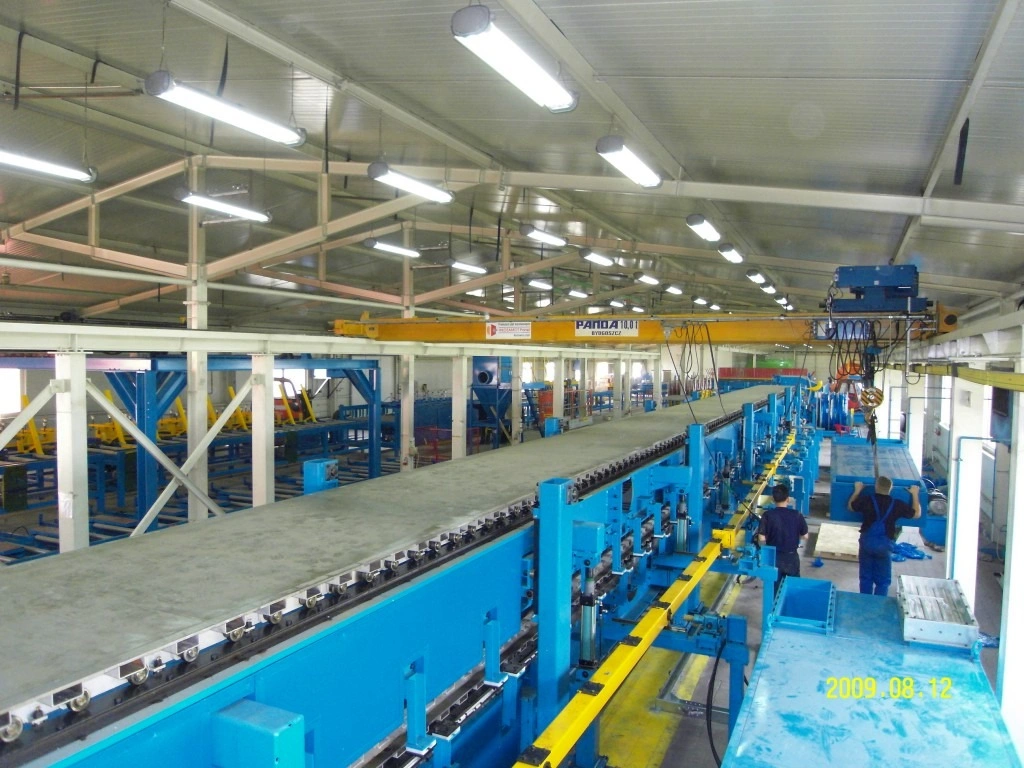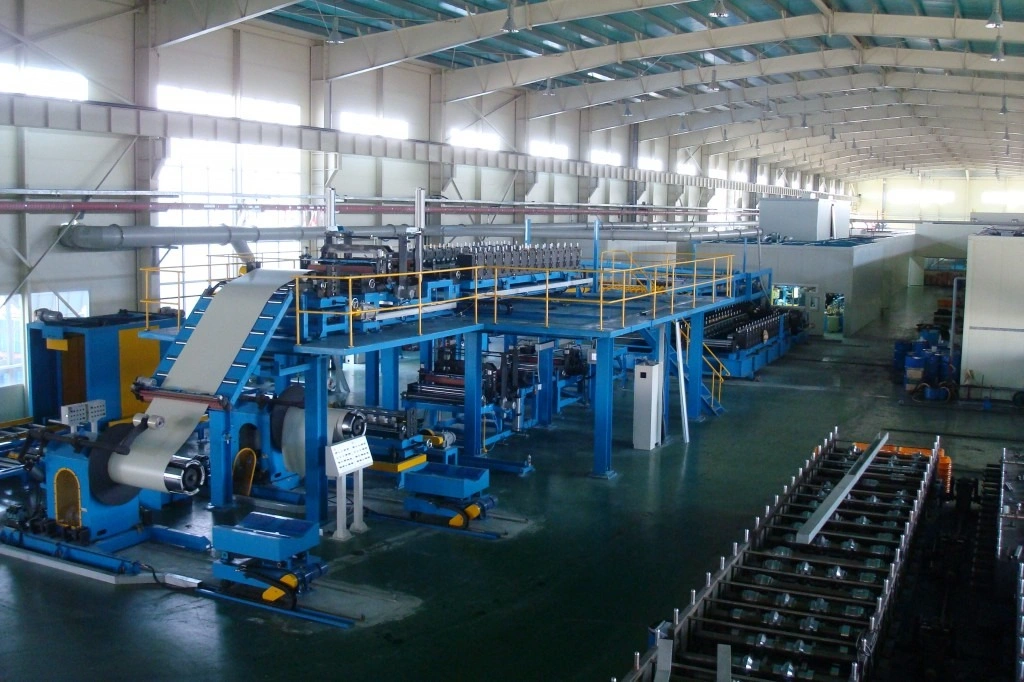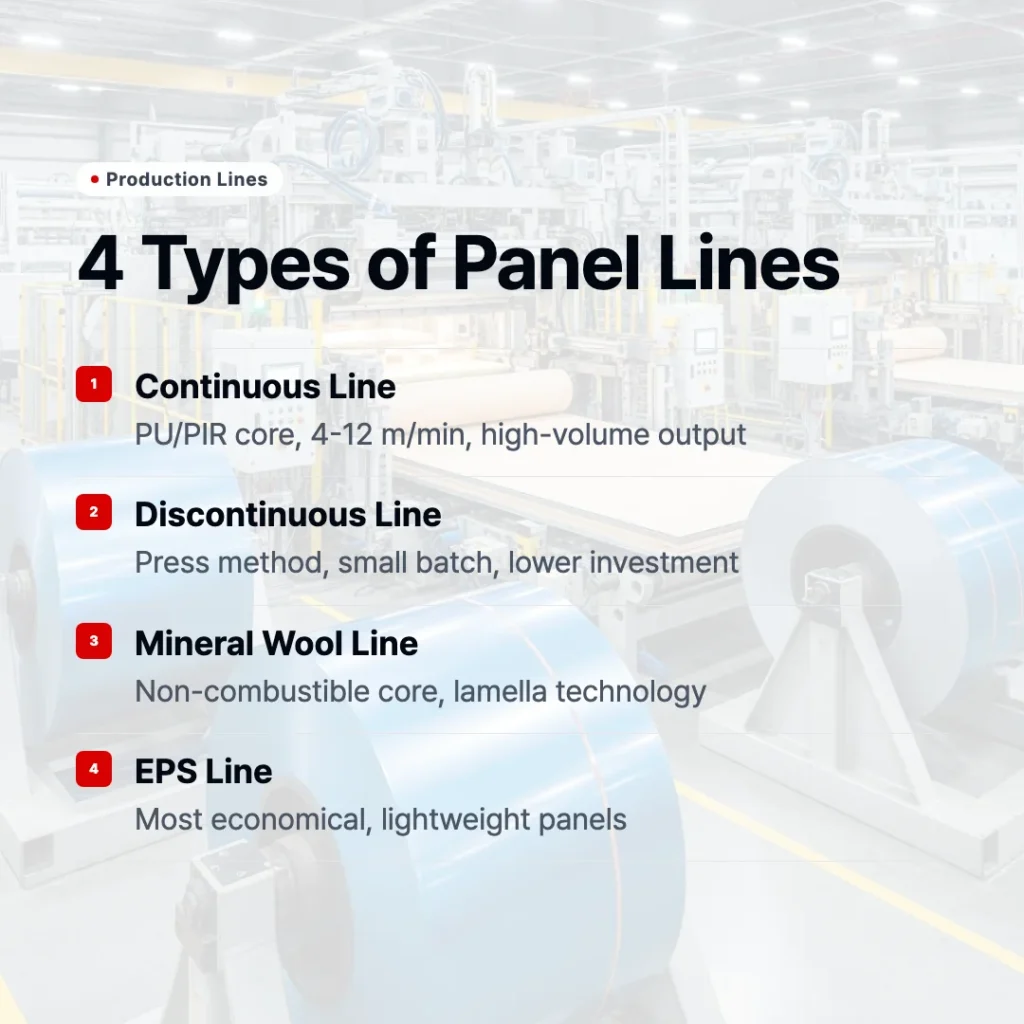
For mineral wool sandwich panels, the single feature that separates a structurally serious panel from a decorative one is how the wool core is oriented inside it. A panel made from flat mineral wool slabs behaves very differently from one whose fibers stand upright between the two steel facings, and the difference is created by one specific station on the line: the lamellar cutting system. For factory owners and engineers evaluating mineral wool equipment, understanding this section is essential, because it governs compressive strength, fire performance, bonding quality, and ultimately the price the finished panel can command.
In this article, we will explore how the lamellar cutting system works, why fiber orientation drives panel strength, what cutting precision and speed are realistically achievable, how the section integrates into the full production line, and how the cutting equipment should be maintained.
Lamellar cutting technology explained
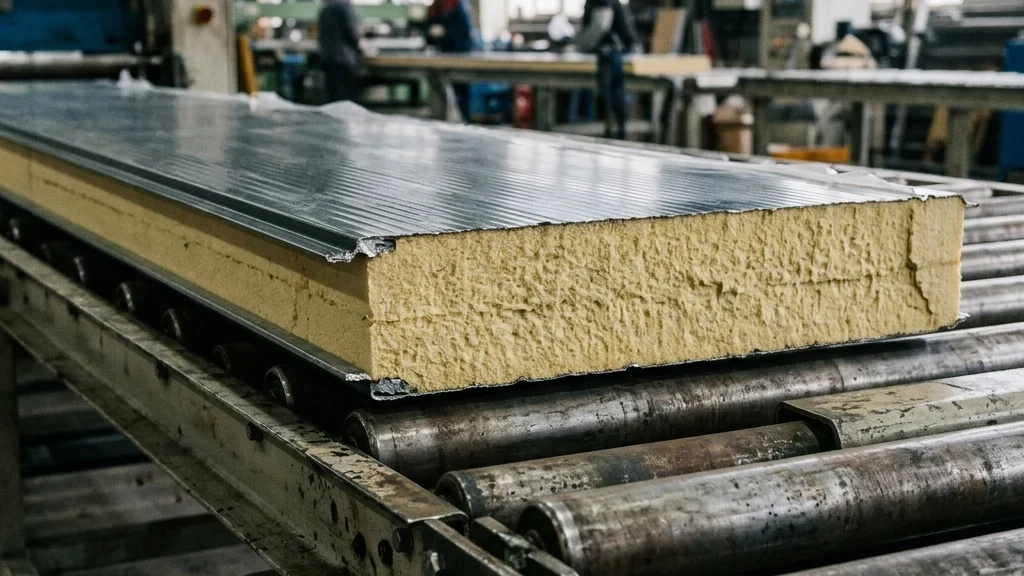
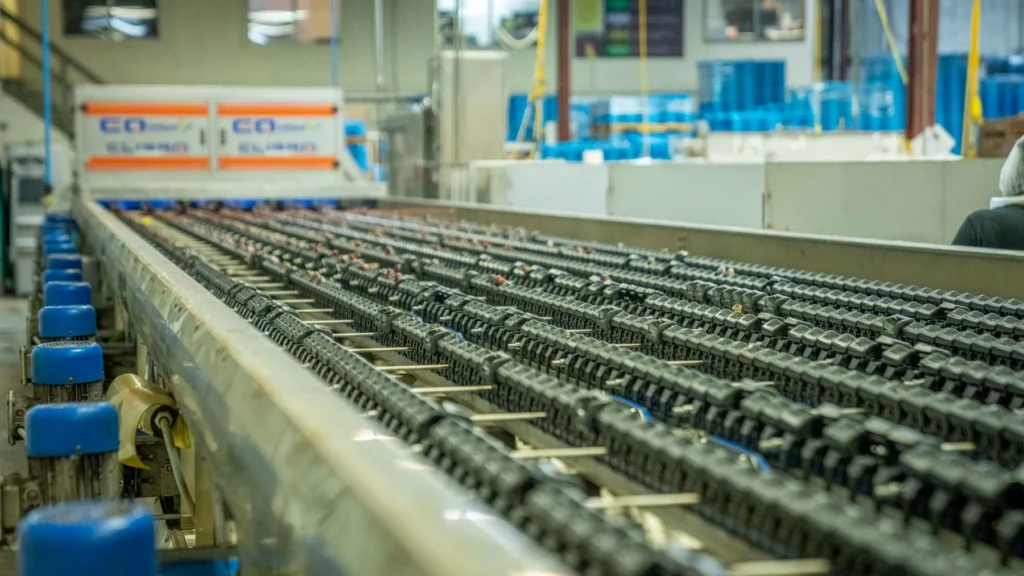
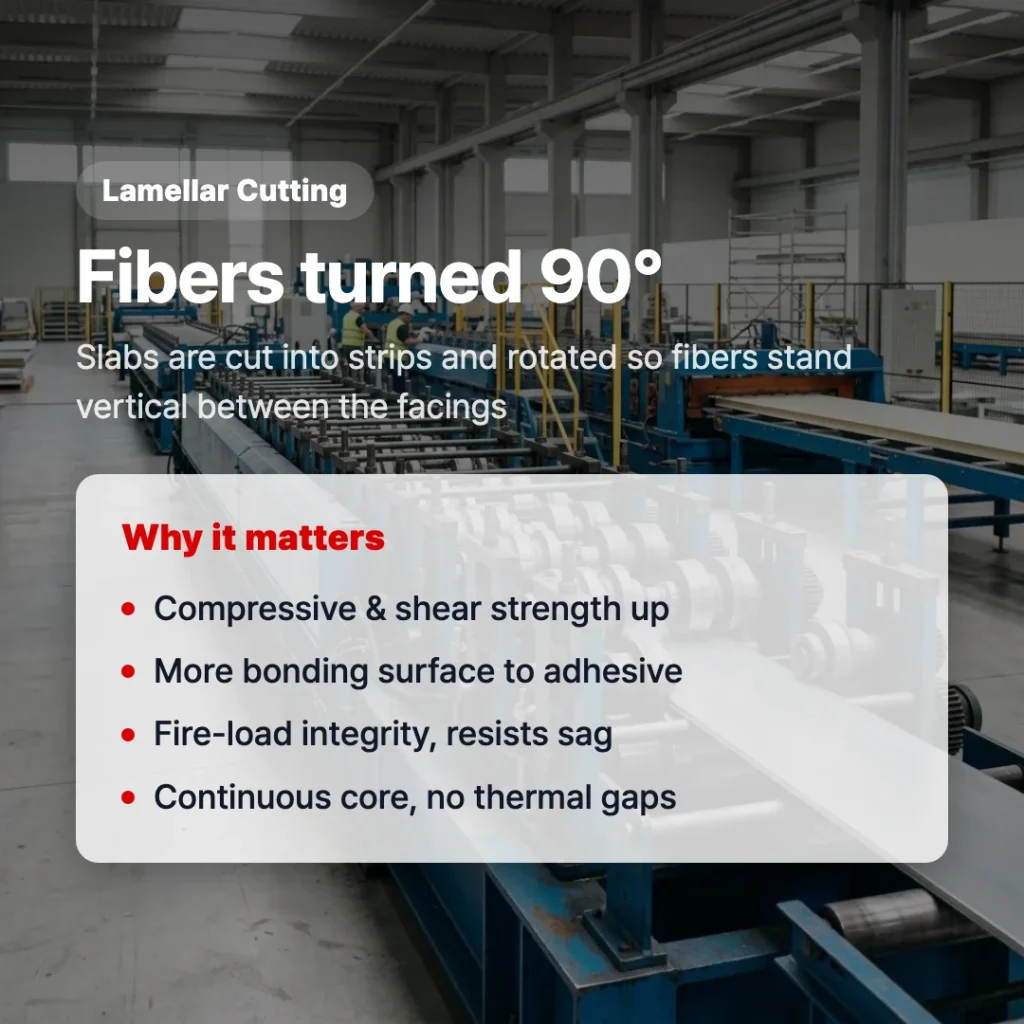
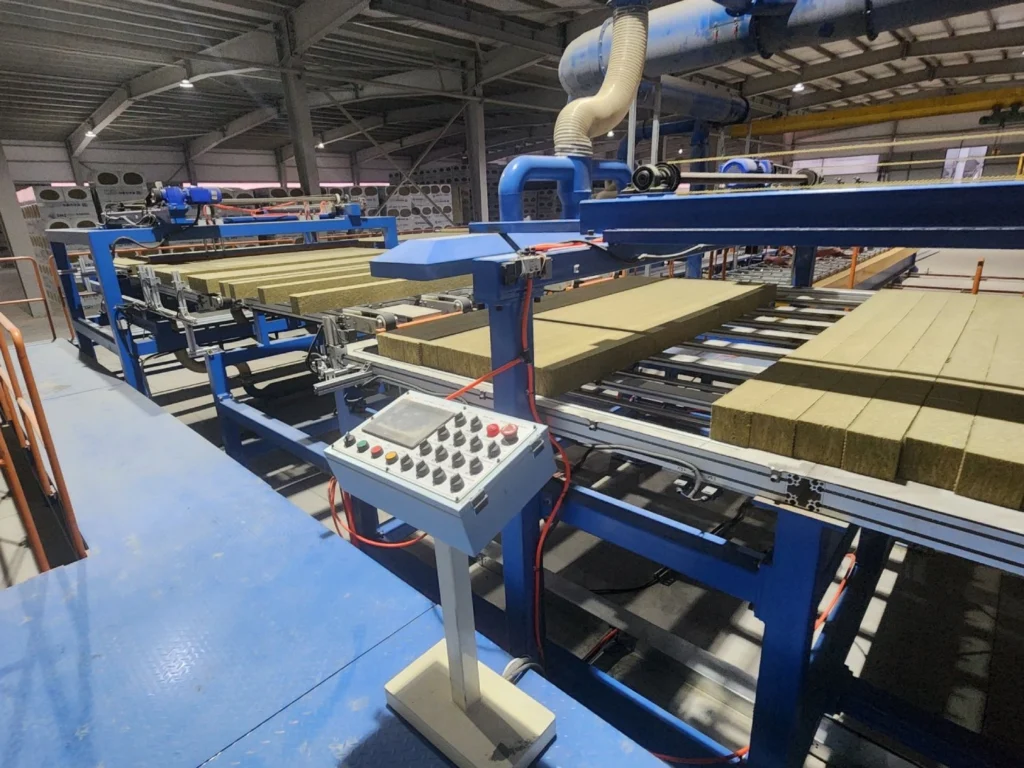
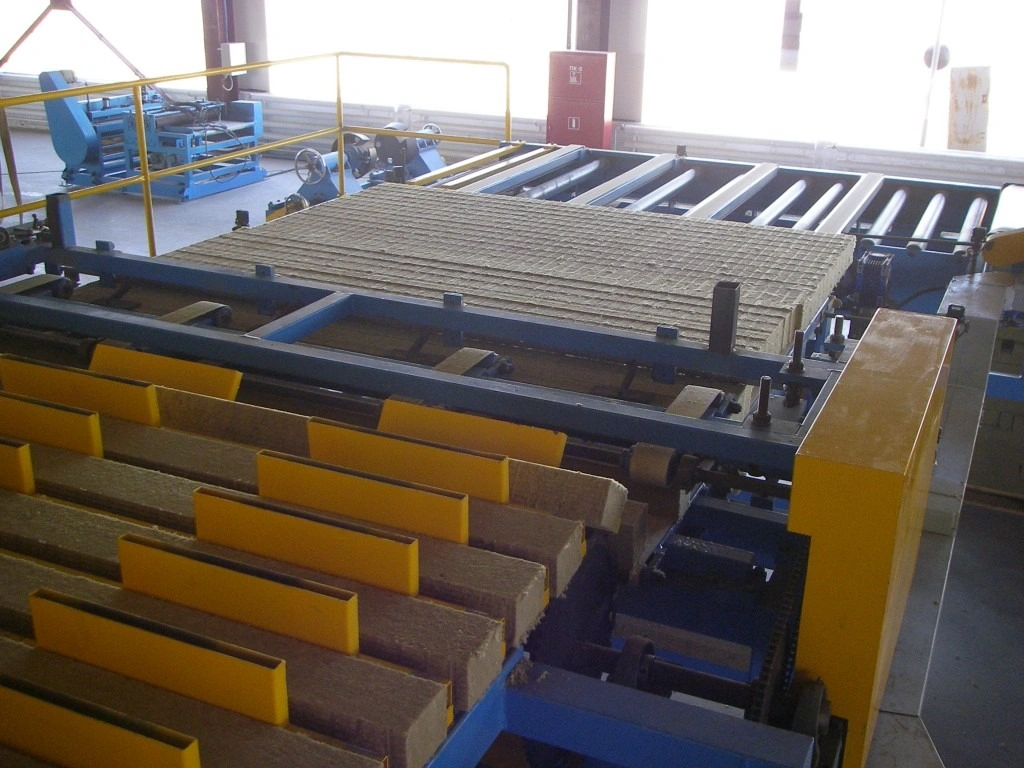
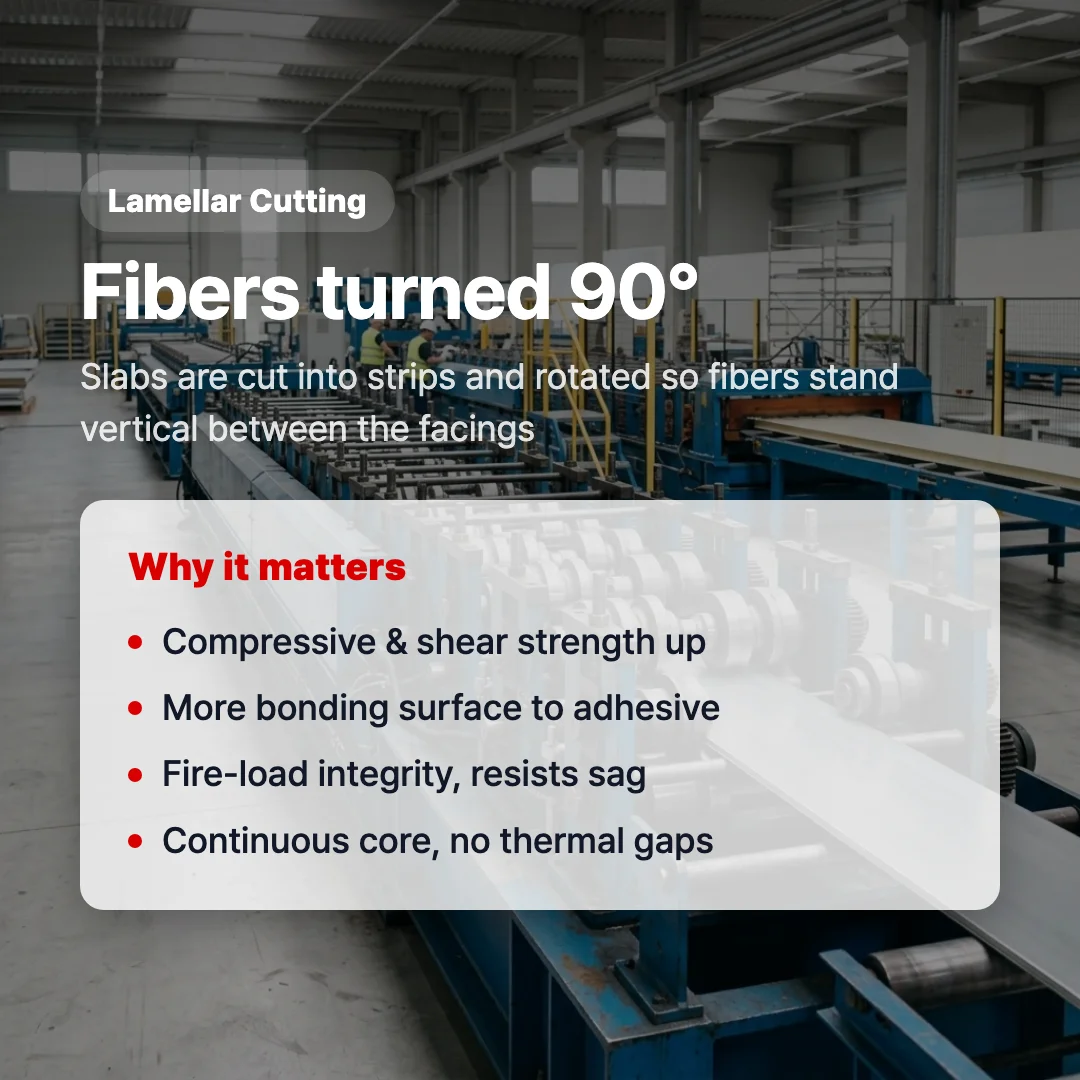
Lamellar cutting is the process of slicing a continuous mineral wool slab or mat into many narrow parallel strips, called lamellas, and then rotating each strip 90 degrees so that its fibers stand perpendicular to the panel facings. In the raw slab as delivered from the mineral wool plant, the fibers lie predominantly flat, running parallel to the large faces of the slab. The lamellar system takes that horizontally fibered material, cuts it across into strips, turns each strip on edge, and reassembles them side by side into a continuous core in which the fibers now run vertically through the panel thickness.
The reason this rearrangement matters comes down to how mineral wool carries load. A loose mat of fibers resists forces far better along the length of the fibers than across them. When the fibers lie flat inside a panel, any compression on the panel face presses across the fibers, where the material is weakest. When the fibers stand vertically, compression and shear are carried along the fiber direction, where the material is strongest. Lamellar cutting is therefore not a cosmetic step or a way to reduce waste; it is the mechanism that converts a soft insulation slab into a load-capable structural core.
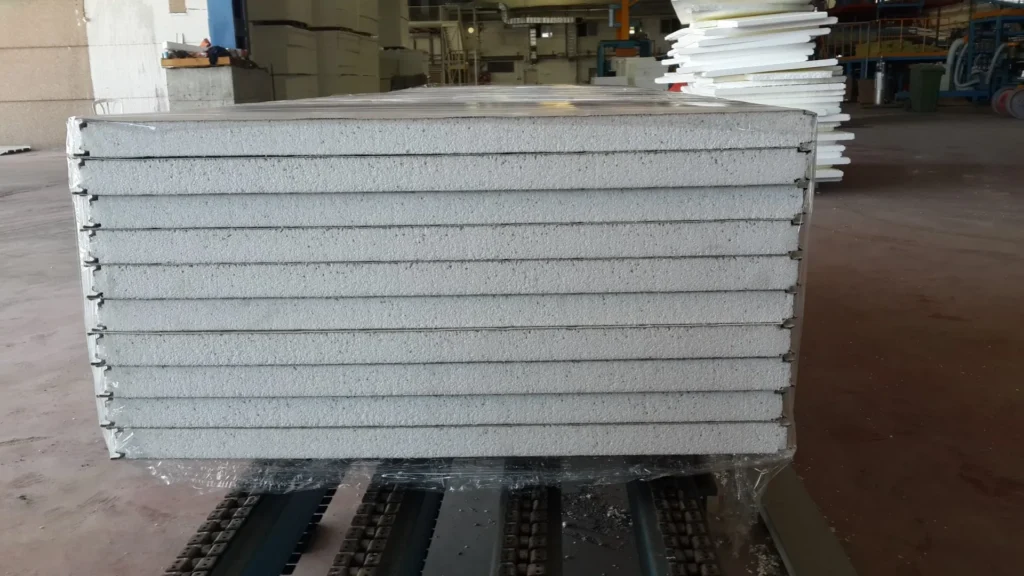
A useful way to picture the geometry is to compare two orientations directly. In a flat-slab core, the fibers are horizontal, parallel to the steel skins, and the slab is bonded to the facings across the weak axis of the wool. In a lamella core, the fibers are vertical, perpendicular to the skins, and every strip presents its strong axis to the load path between the two facings. The flat-slab arrangement is simpler and cheaper to produce but yields a panel with modest compressive and shear capacity; the lamella arrangement requires the cutting and turning station but produces a panel that can handle real wall and roof loads and behaves predictably in fire.
Does every mineral wool panel use lamellar cutting?
No. Lower-grade or purely insulating mineral wool panels can be made with flat slabs, which is faster and avoids the cutting section entirely. But panels intended for structural walls, high fire-rating requirements, or demanding facade applications almost always use vertically oriented lamellas, and that is why the cutting system is the defining station of a serious mineral wool line.
Fiber orientation and panel strength
The performance gap between horizontal and vertical fiber orientation is large and shows up across several properties at once. With fibers standing vertically, compressive strength improves dramatically because the load passes down the length of the fibers rather than crushing them sideways. Shear strength rises for the same reason, which is critical for spanning panels that must resist deflection under wind and dead loads. The bonding surface area between core and facing also changes character: the cut fiber ends presented to the adhesive create a more favorable, more numerous set of contact points than the smooth flat face of an uncut slab, improving the mechanical key between core and steel.
Fire-load integrity is the property where vertical orientation is most decisive. Mineral wool is non-combustible, but a panel’s fire rating depends not only on the material but on whether the core holds together and stays bonded to the facings as temperatures climb. Vertically oriented lamellas resist the sagging and pull-away that flat slabs are prone to under thermal load, helping the panel maintain its integrity and insulation rating for the required duration. This is why mineral wool panels marketed for high fire classifications are built on lamella cores rather than flat slabs.
The strength benefit is only realized if the lamellas are cut and assembled cleanly. Consistent strip width is what keeps the reassembled core continuous; if strips vary in width, gaps open between them, and each gap is a thermal bridge and a structural weak point that undermines the very advantage the lamella construction was meant to deliver. Thickness and flatness tolerance matter just as much, because the core has to meet the facings evenly across its whole surface. An uneven core leaves the adhesive bridging voids in some places and over-compressed in others, which leads to voids and delamination once the panel is in service.
Core density is part of this equation. Mineral wool cores span roughly 40 to 150 kg/m³, with structural panels toward the denser end, and the lamella geometry has to suit that density. Strip widths are commonly in the tens of millimeters, on the order of a few centimeters, narrow enough to turn cleanly and reassemble into a uniform core but wide enough to handle and bond efficiently. Getting these parameters matched to the intended panel thickness and fire class is part of configuring the section correctly rather than something the operator adjusts arbitrarily.
Cutting precision and speed
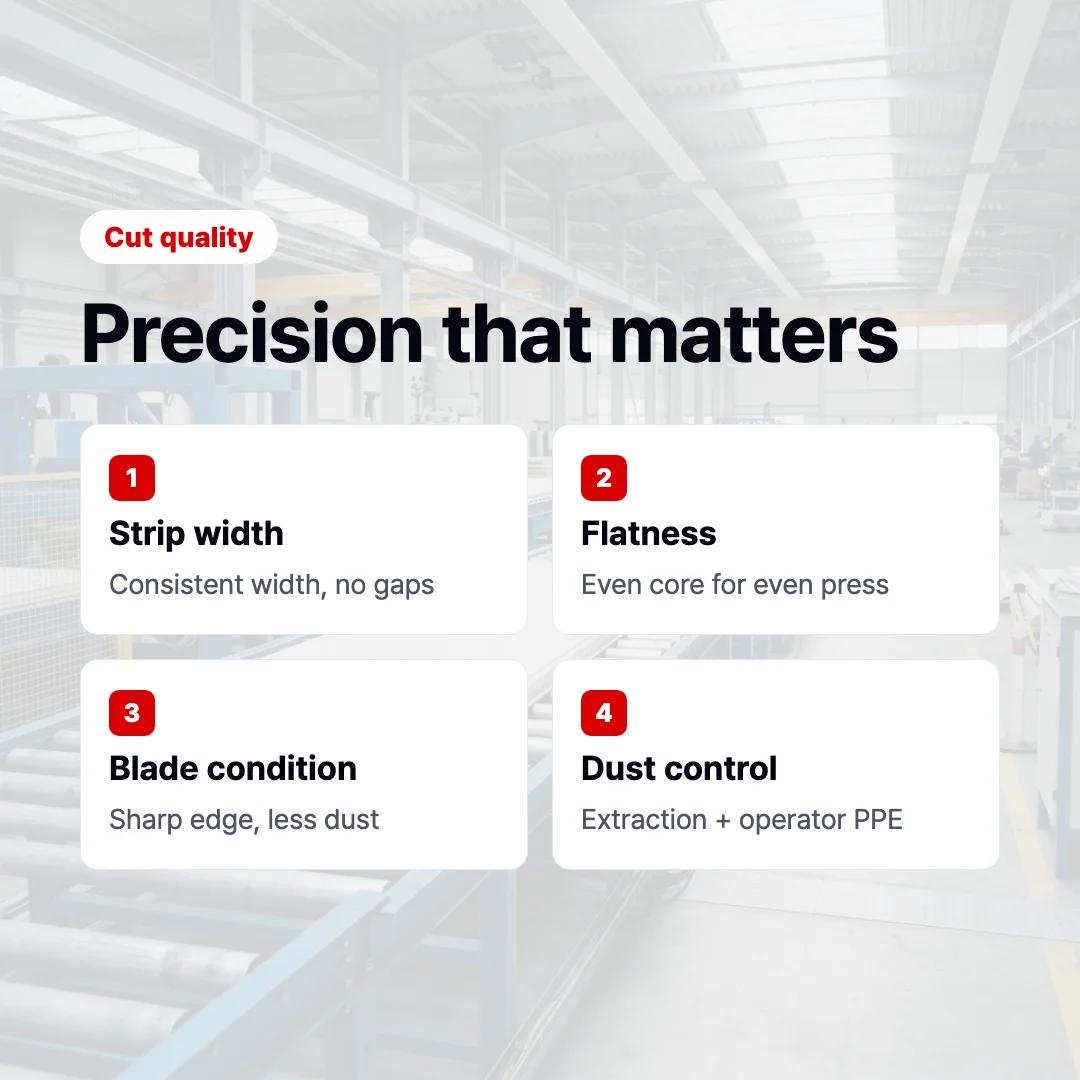
Precision in the lamellar section is about repeatability more than any single headline tolerance. The cutting tools, typically high-speed blades or saws, must produce strips of consistent width and square, clean edges run after run, hour after hour. Achievable accuracy on a well-configured line keeps strip width variation small enough that the reassembled lamellas butt together without visible gaps, and edge quality stays clean enough that adjacent strips sit flush rather than riding up on burrs or frayed fiber. Quoting an exact figure in millimeters is less meaningful than understanding that the target is a core with no cumulative width drift across the panel and no localized gaps.
Two precision factors deserve specific attention. The first is strip width consistency, because width errors accumulate across the panel and either leave the core short of the facing edges or force strips into compression that distorts the assembly. The second is thickness and flatness of the finished core, because the double belt press downstream applies even pressure and cure time across the whole panel; a core that is high in one zone and low in another will bond unevenly, producing the voids and delamination noted earlier. Precision at the cutting station is therefore a direct input to bond quality at the press.
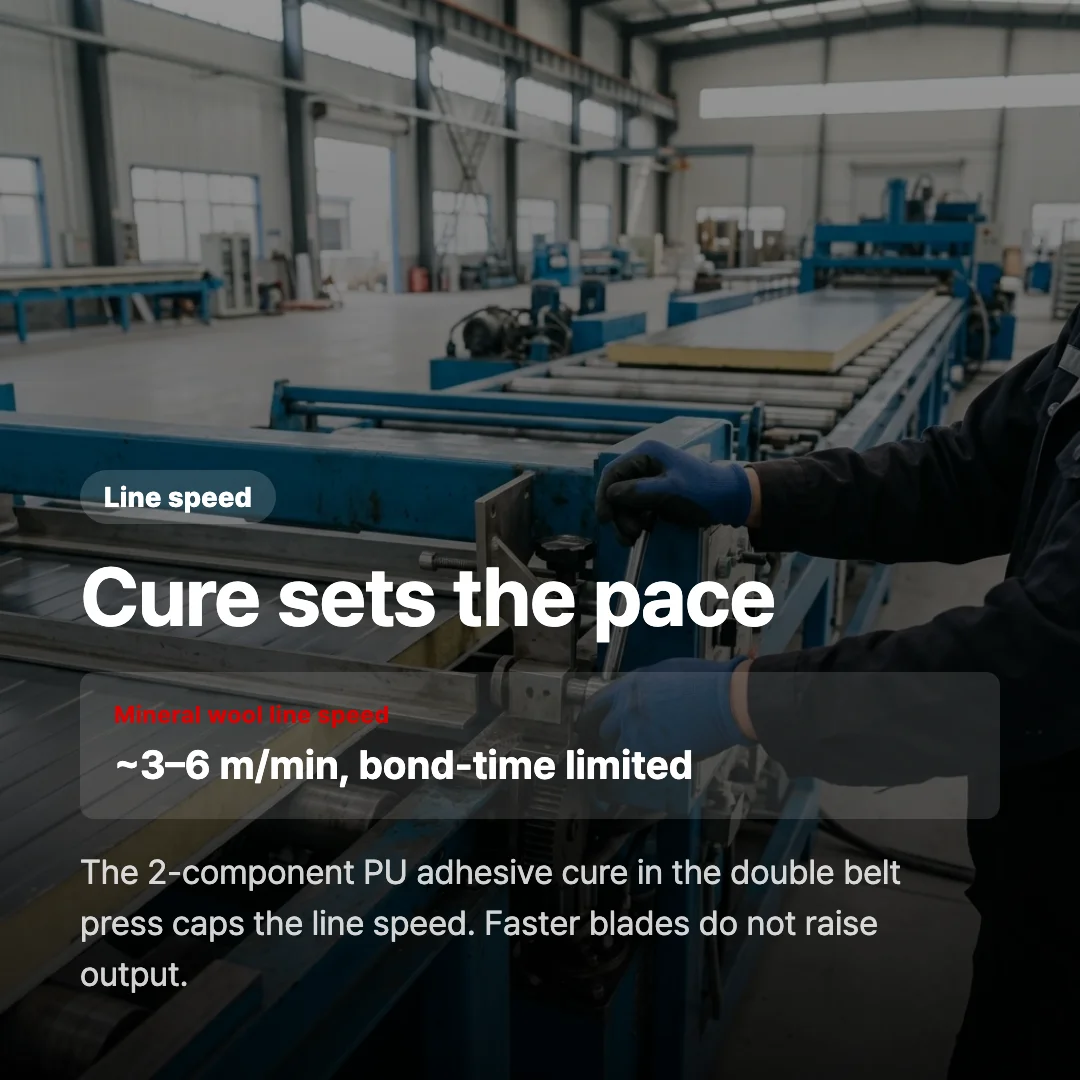
Speed in a mineral wool line is fundamentally different from a PU line and is set by chemistry, not by how fast the blades can move. The 2-component PU adhesive used to bond the mineral wool core to the steel facings needs time to cure inside the double belt press, and that cure time caps the line speed. For mineral wool, practical line speeds commonly run in the range of about 4 to 16 m/min, with the press bond time — not the cutters — setting the ceiling. The cutting and turning station must keep pace reliably at that speed, but pushing the cutters faster does not raise output if the press cannot cure faster. This is why the cutting section is engineered for consistency and uptime rather than raw cutting velocity.
Blade condition feeds directly into both precision and speed. As blades wear, edge quality degrades, cut faces become ragged, and dust generation increases, all of which compromise the clean butt joints the core depends on. Worn tooling can also force a slower feed to maintain acceptable cut quality, eroding the line’s effective throughput. Treating blade wear as a scheduled, monitored variable rather than a run-to-failure item is one of the most direct levers an operator has over both panel quality and output.
Integration with the production line
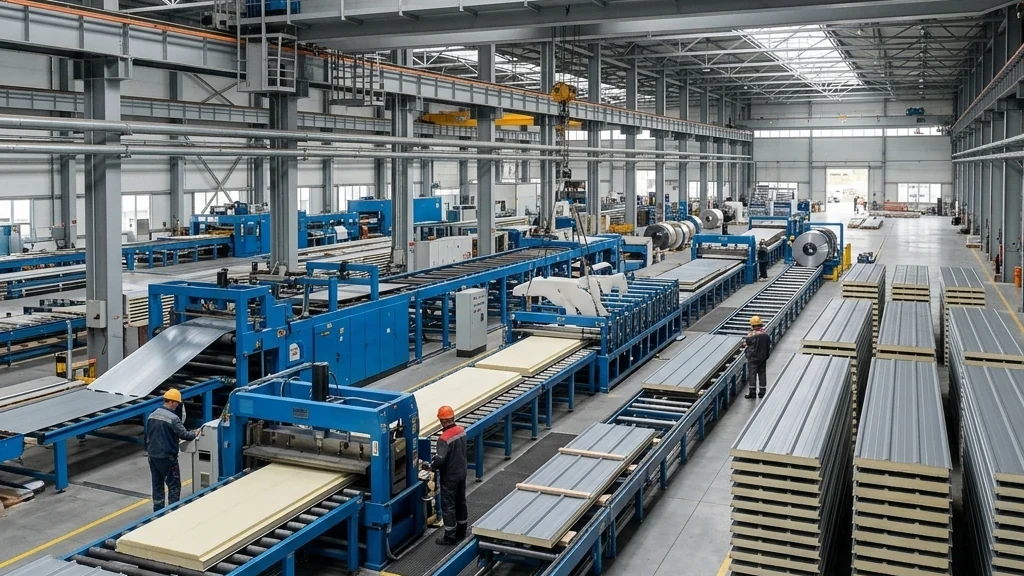
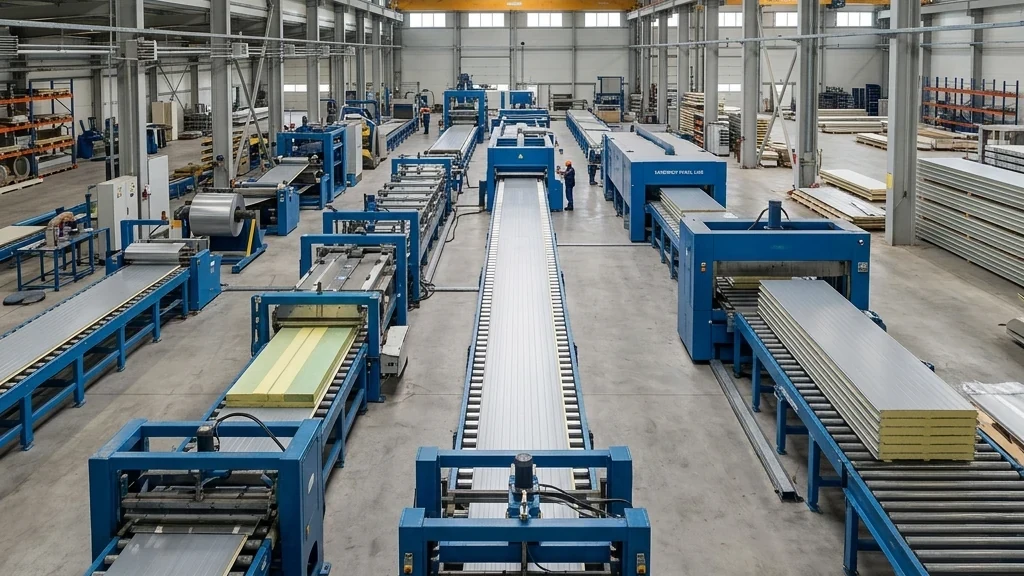
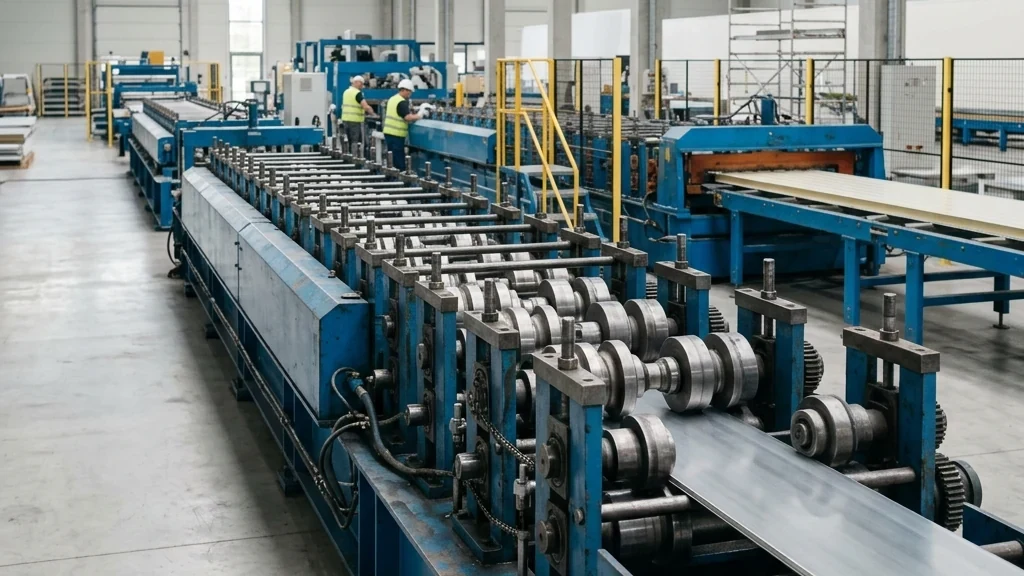
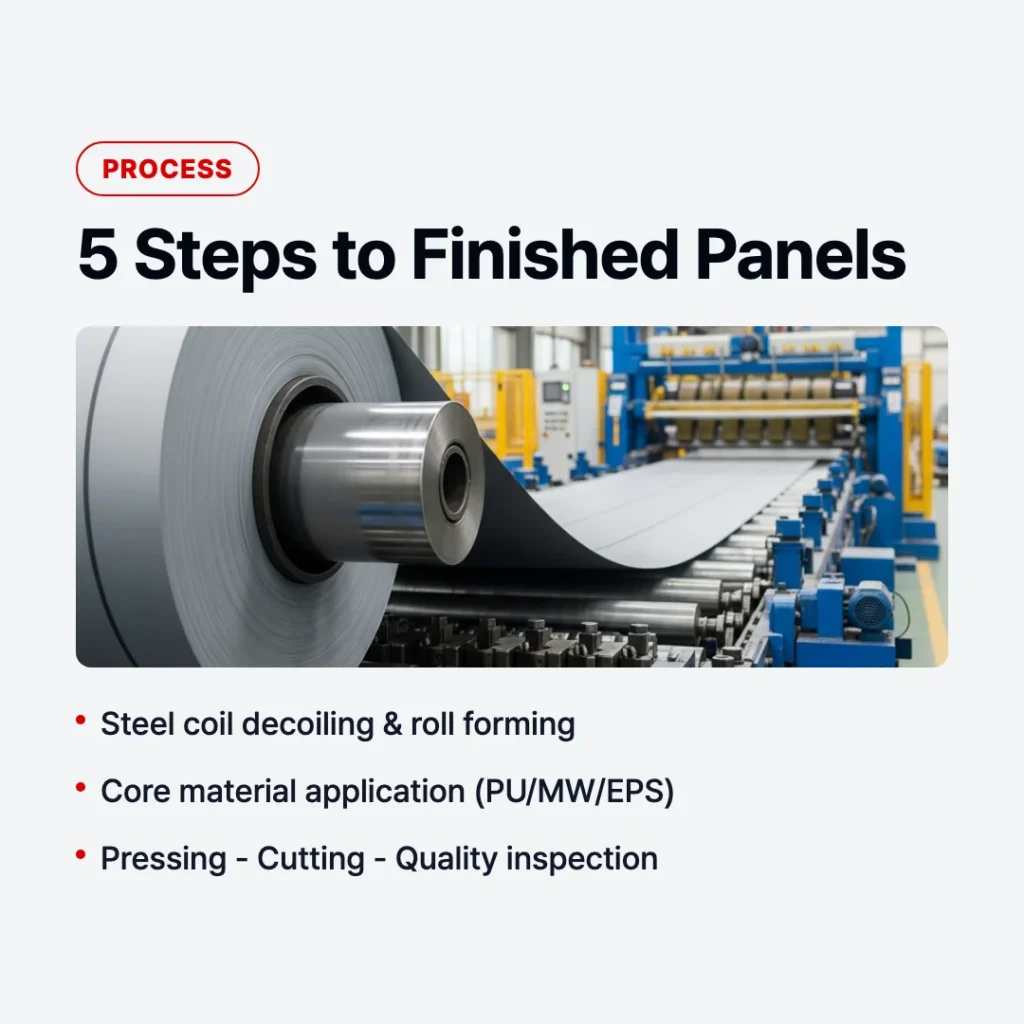
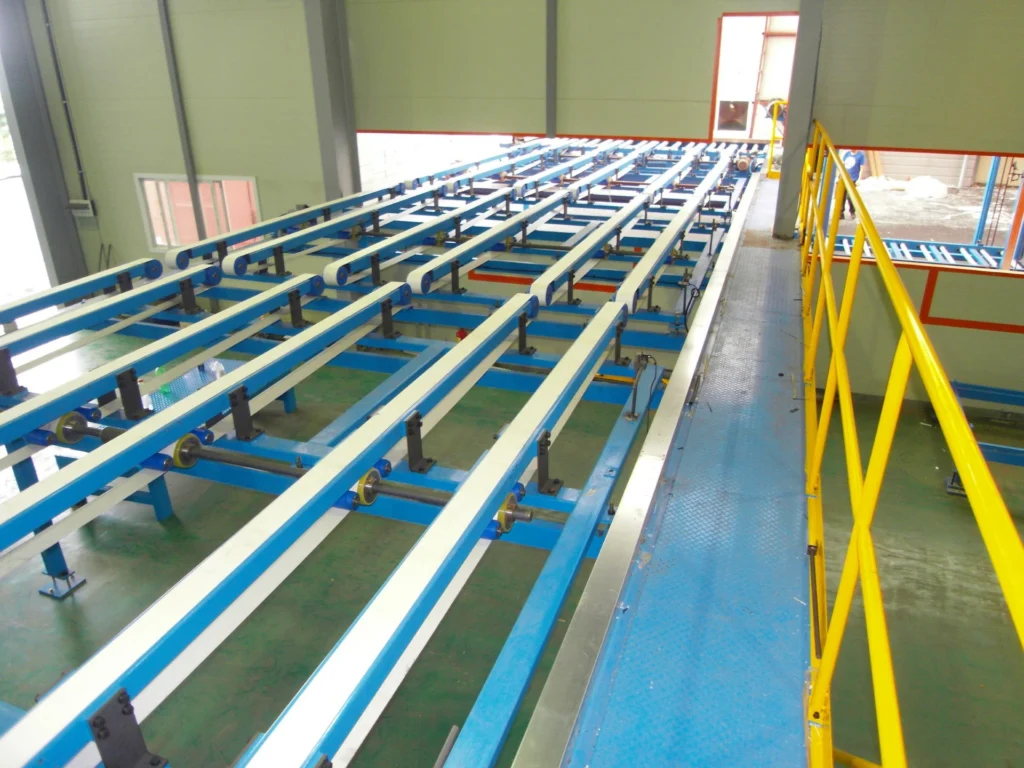
The lamellar cutting system is not a standalone machine; it is one stage in a continuous sequence, and its position determines how it must behave. On a mineral wool sandwich panel line the flow runs from decoiler to roll former to glue applicator, then to the combined wool feeding, lamellar cutting, and strip turning station, then into the double belt press, and finally to the flying saw and stacker. The lamella section sits squarely between the wool feeding and the glue and press stations, which means it has to deliver a finished, correctly oriented, dimensionally stable core into the press exactly when the adhesive-coated facings arrive. For the full upstream and downstream context of the line, see our overview of mineral wool line technology.
Because the section feeds a continuous press, synchronization is everything. The strips must be cut, turned, and assembled at a rate that matches the line speed without buffering gaps or surges, and the core has to enter the press flat and complete so the 2-component PU adhesive and the double belt press can cure a uniform bond. Any hesitation or width error in the lamella section propagates downstream as a press defect, which is why this station is engineered as an integrated part of the line rather than a bolt-on. The presence of this cutting and turning section is also the single most visible thing that distinguishes a mineral wool line from a foam line; for how that plays out across the two processes more broadly, see our mineral wool vs PU comparison.
This is where supplier configuration becomes decisive. KINDUS configures the lamellar and wool-handling section to the client’s panel thickness range and line speed, so the cutting geometry, strip width, turning mechanism, and feed rate are matched to the specific products the factory intends to make rather than set to a generic default. A line built to produce thin 50 mm partition panels and one built for thick high fire-rating wall panels need different lamella parameters, and getting that match right at the engineering stage avoids costly rework once the line is running.
Maintenance of cutting equipment
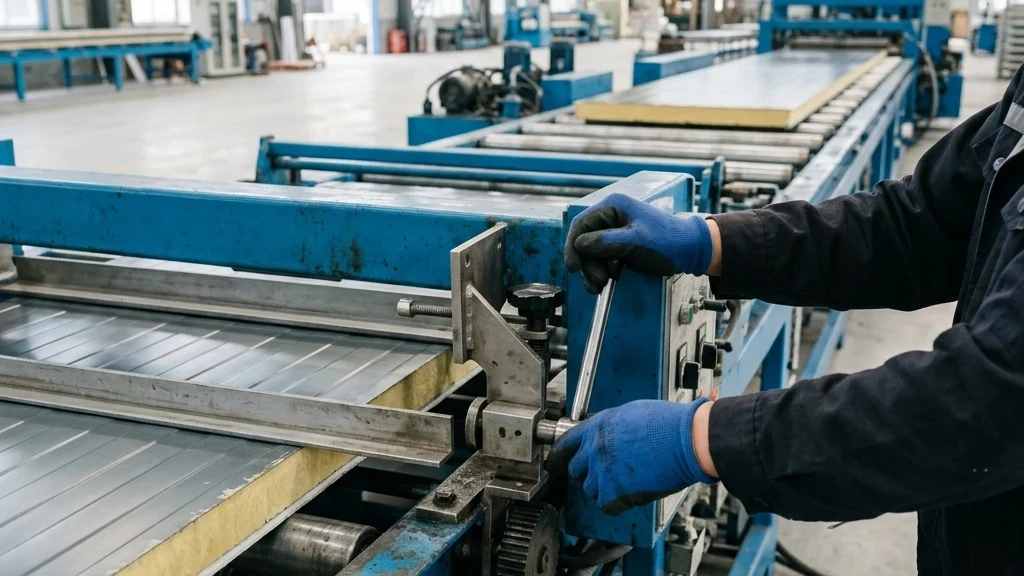
Maintenance of the cutting section centers on the tooling, the dust management, and the dimensional checks that keep the core within tolerance. Blades and saws are wear items, and their condition maps directly to edge quality, strip-width accuracy, and dust generation, so a disciplined inspection and replacement schedule is the foundation of keeping the panel within spec. Beyond the blades, the strip-turning mechanism and the feed and alignment systems need regular checking, because a turning station that drifts out of alignment will reassemble the lamellas with subtle gaps or angle errors that only show up as press defects later.
Dust and operator safety are not secondary considerations here; they are part of the section’s design and its maintenance routine. Mineral wool fiber is a respiratory irritant, and cutting it generates airborne fiber and dust. Effective dust extraction at the cutting point and operator PPE are built into the cutting-section design, and keeping the extraction system clean and functioning is a maintenance task in its own right. A clogged or underperforming extraction system both raises the health risk and lets dust settle on the cut faces, which interferes with adhesion at the press.
A practical maintenance and quality checklist for the lamellar cutting section includes the following:
- Inspect blades and saws on a defined schedule; replace before edge quality and dust generation degrade rather than running to failure.
- Verify strip-width consistency with periodic measurements so cumulative drift and gaps are caught early.
- Check core thickness and flatness so the double belt press bonds evenly and voids and delamination are avoided.
- Confirm the strip-turning and alignment mechanism keeps fibers truly vertical and strips butted without gaps.
- Service and clean the dust extraction system, and confirm operator PPE and air monitoring are in use at the cutting station.
- Keep cutting parameters matched to the panel thickness range and line speed the section was configured for.
Backing the maintenance program with proper engineering support matters over the life of the line. KINDUS, manufacturing sandwich panel production lines since 1995 with more than 170 projects delivered across over 40 countries and 30 years of experience, provides CE-certified equipment and the documentation and support that let a maintenance team keep the lamellar section in spec for the long term. Treating the cutting station as a precision asset rather than a consumable-driven afterthought is what keeps mineral wool panel quality stable across thousands of running hours.
What is lamellar cutting for mineral wool?
Lamellar cutting is the process of slicing a mineral wool slab or mat into narrow strips called lamellas and rotating each strip 90 degrees so the fibers stand perpendicular, or vertical, to the panel facings. The turned strips are reassembled side by side into a continuous core. This converts the soft, horizontally fibered raw slab into a structurally capable core with high compressive and shear strength.
How does fiber orientation affect panel strength?
Mineral wool carries load best along the fiber direction and poorly across it. With horizontal flat-slab fibers, the core is compressed across its weak axis, giving modest strength. With vertical lamella fibers, compression and shear pass along the strong axis, dramatically improving compressive strength, shear strength, the bonding surface presented to the adhesive, and fire-load integrity because the core resists sagging and pull-away under heat.
What cutting precision is achievable?
The meaningful target is repeatable strip-width consistency and clean, square edges run after run, so the reassembled lamellas butt together with no gaps and no cumulative width drift across the panel. Equally important is core thickness and flatness, since the double belt press needs an even core to bond uniformly. Maintaining sharp blades and good alignment is what keeps this precision stable; worn tooling raises width variation, dust, and edge defects.
Planning a mineral wool line with the lamellar cutting matched to your thickness range and line speed? See how the full line is engineered on the Mineral Wool Sandwich Panel Line page.