Many panel producers reach a point where standard PU cores no longer pass the fire codes their markets demand. Building regulations tighten, insurers ask for better reaction-to-fire classes, and a polyurethane line that runs beautifully suddenly falls short on a project spec. The frustrating part is that the machine is often fine. The gap sits in the chemistry, and more precisely in how the recipe is metered, mixed, and cured on a continuous line. Understanding that difference is what separates a producer who switches cores in an afternoon from one who fights foam defects for weeks.
In this article, we’ll look at how a continuous PIR sandwich panel line differs from a PU line, how the isocyanate index and recipe are controlled, how gel and cream times drive belt tuning, and why PIR earns its fire performance advantage.


- Same double belt, laminator and mixing head
- PIR needs higher index and hotter cure zones
- Switchover by recipe, often within ~30 minutes
PIR vs PU on a continuous line
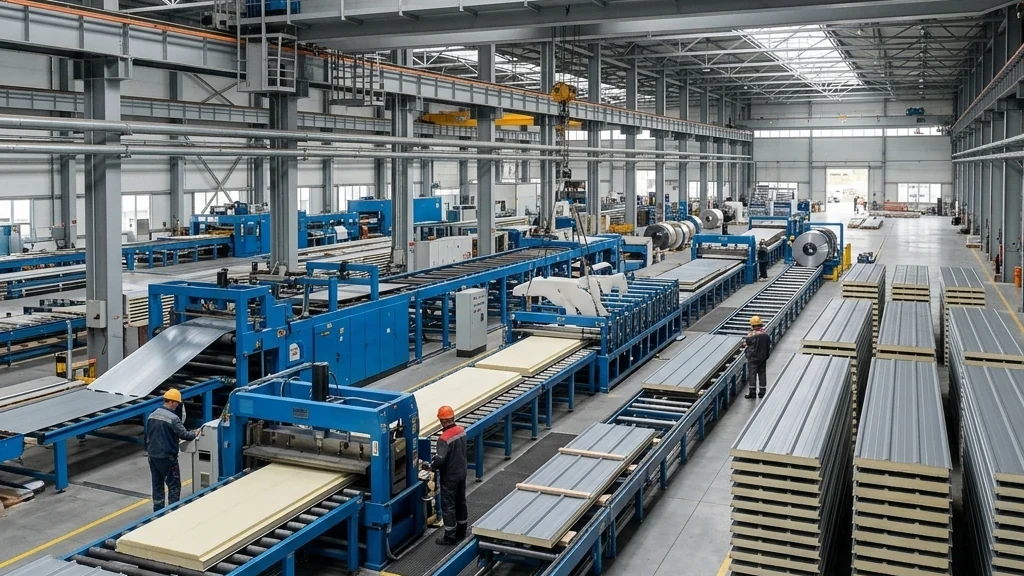
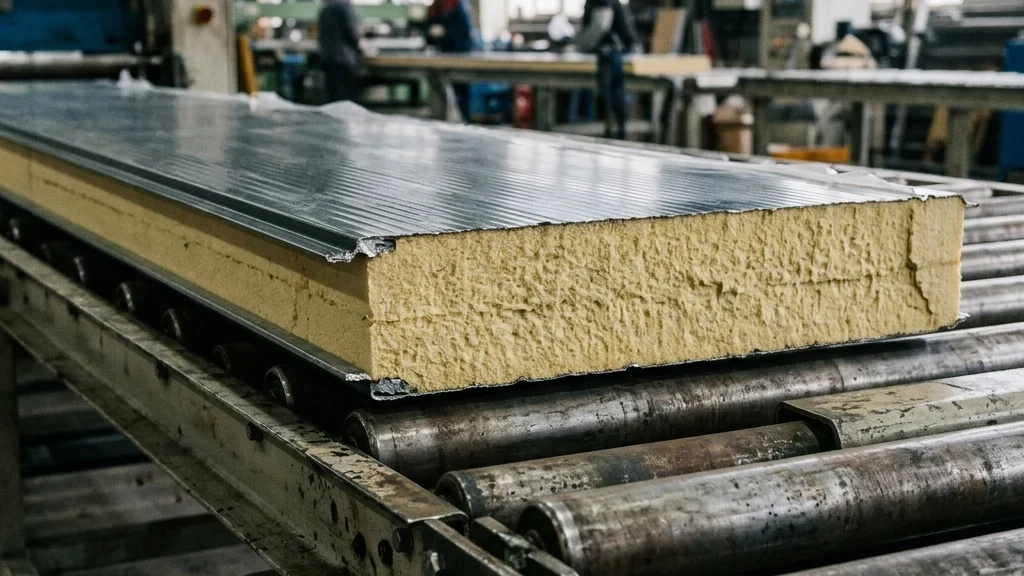
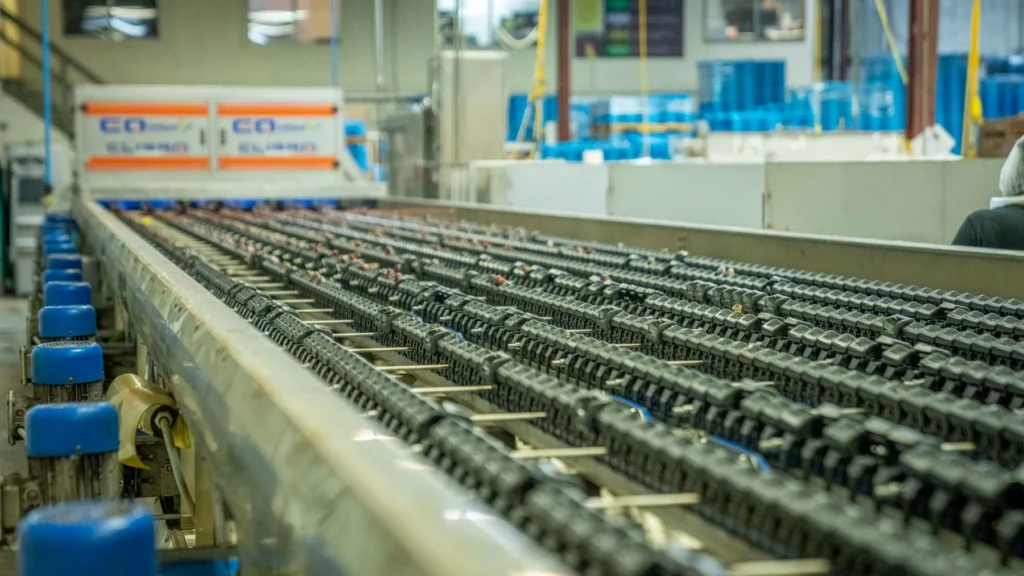
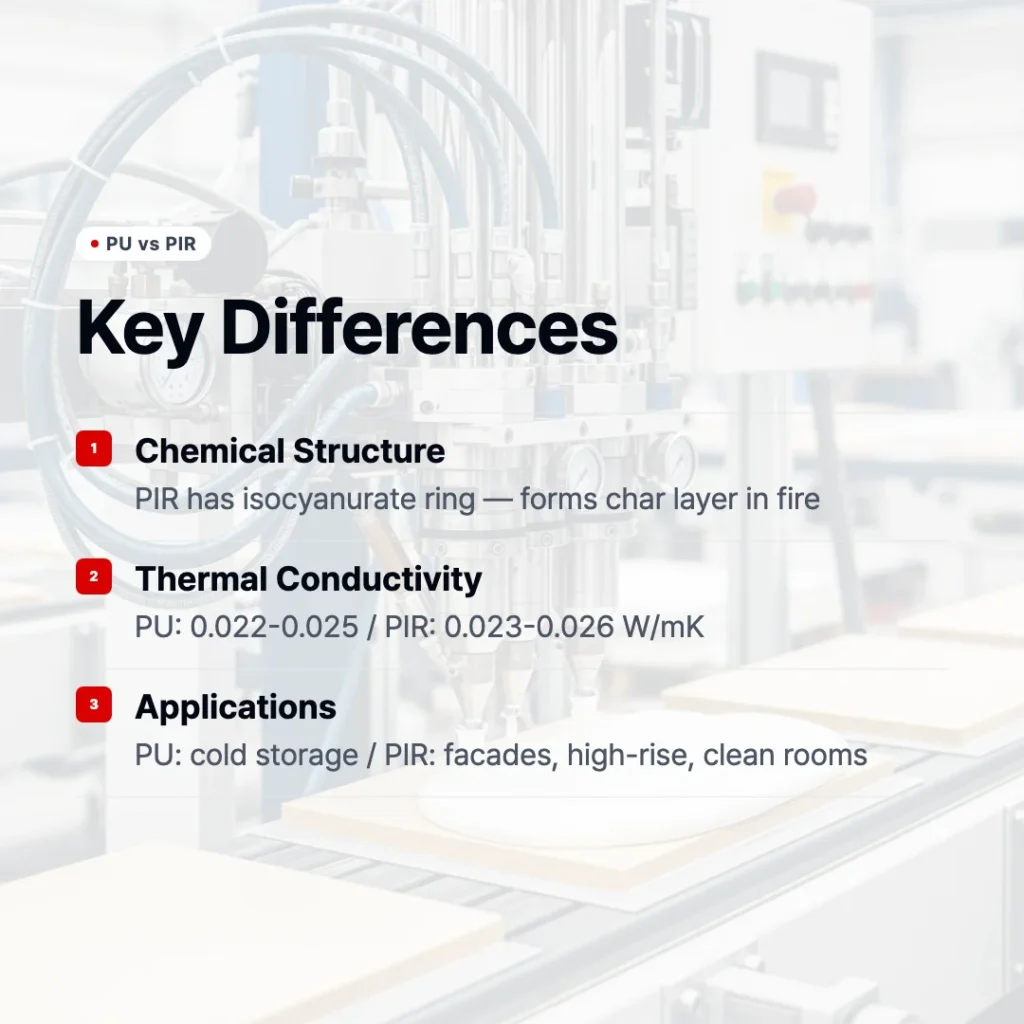
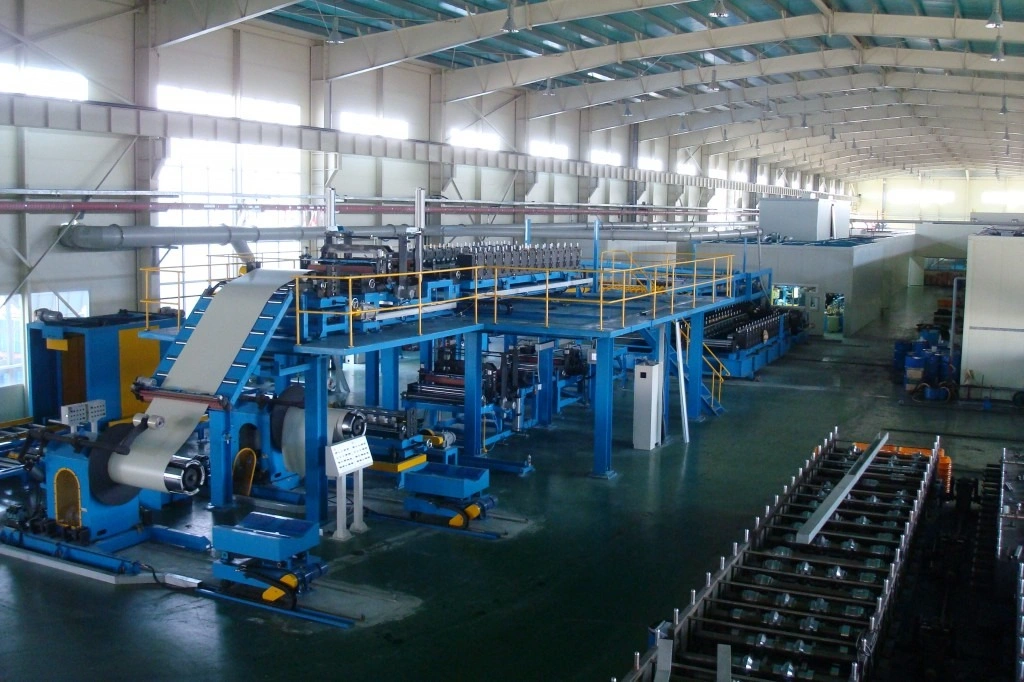
PIR, or polyisocyanurate, is a rigid foam produced by running the same isocyanate and polyol chemistry as PU but at a much higher isocyanate ratio so that excess isocyanate forms stable isocyanurate ring structures. On a continuous line the mechanical path is nearly identical to PU: the same double belt, the same laminator, the same metering and mixing head. What changes is the formulation and the thermal profile. A PU foam relies mostly on urethane linkages, while a PIR foam adds trimerized isocyanurate rings that give it a tougher, more thermally stable backbone.
The practical comparison matters for anyone planning capacity. PU cures faster and is more forgiving at the edges, which makes it the easier core to run at high line speed. PIR needs tighter temperature and index control but rewards you with better fire behaviour at the same panel thickness. Thermal conductivity is close between the two, with PU around 0.022 to 0.025 W/mK and PIR around 0.023 to 0.026 W/mK, so the decision is rarely about insulation value and almost always about fire class and regulatory fit.
At KINDUS, we treat PU and PIR as two recipes on one platform rather than two separate machines, which is why a well-built continuous line can serve both markets without a second capital investment. If you want the mechanical baseline first, the Continuous PU Sandwich Panel Line: Configuration, Specs & Throughput walks through the shared line architecture that PIR production builds on.
Isocyanate index and recipe control
- Can I run PIR on my existing PU line?Usually yes — the hardware is shared. It is mainly a recipe and thermal change if metering and temperature control are precise enough.
- What sets the cure window?Line speed and thickness together, typically 4–12 minutes. Trimerization is heat-driven, so PIR zones run hotter than PU.
The isocyanate index is the ratio of isocyanate actually supplied to the amount stoichiometrically needed to react with the polyol, expressed as a percentage where 100 means an exact balance. PU foams typically run close to that balance, while PIR pushes the index far above it, into the 200 to 300 range, so that leftover isocyanate can trimerize into isocyanurate rings. That single number is the clearest chemical marker separating the two foams.
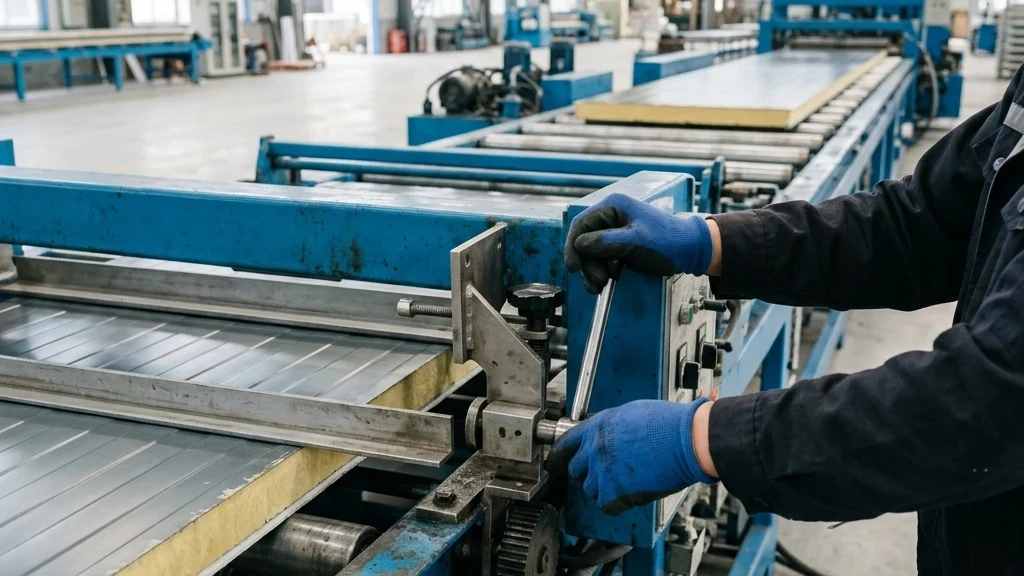
Holding that index steady is where metering accuracy earns its keep. A continuous line that meters components to ±0.5% keeps the index inside its window batch after batch, and a mixing head running impingement pressure in the 120 to 180 bar range gives the fine, even cell structure that a high-index PIR foam needs to cure cleanly. When the index drifts low, you lose char-forming capacity and fire performance; when it drifts high without enough catalyst and heat, you get friable foam and poor adhesion. A common question at this stage:
Can I run PIR on my existing PU line?
In most cases yes, because the line hardware is shared. A well-designed continuous line switches between PU and PIR through recipe changes alone, often inside about 30 minutes, provided the metering and temperature control are precise enough to hold the higher index.
Gel time, cream time, and belt temperature tuning
Cream time is the interval from mixing until the reacting blend starts to expand, and gel time is the point where the foam sets enough to hold its shape. On a continuous line these two clocks have to line up with belt speed so the foam rises and gels in the right place between the facings. If the foam creams too early it distorts the entry into the laminator, and if it gels too late it never develops full strength before cutting.
PIR complicates this because trimerization is temperature-driven and needs more heat than a urethane reaction. That is why belt and oven zones for PIR run hotter, and why line speed and thickness together set the cure window, which sits in the 4 to 12 minute range depending on panel build. A practical tuning checklist for a continuous PIR run:
- Confirm the isocyanate index sits in the target PIR window before starting
- Raise belt and oven zone temperatures relative to your PU baseline to drive trimerization
- Match line speed to panel thickness so gel completes inside the cure window
- Verify cream time keeps foam rise centered in the laminator, not at the entry
- Check adhesion and core strength on the first cut panels, not just density
The core-material fundamentals behind these settings are covered in the PU/PIR Sandwich Panel Machine: Complete Technical Overview, which is useful reading before you dial in a new recipe.
Fire performance advantage
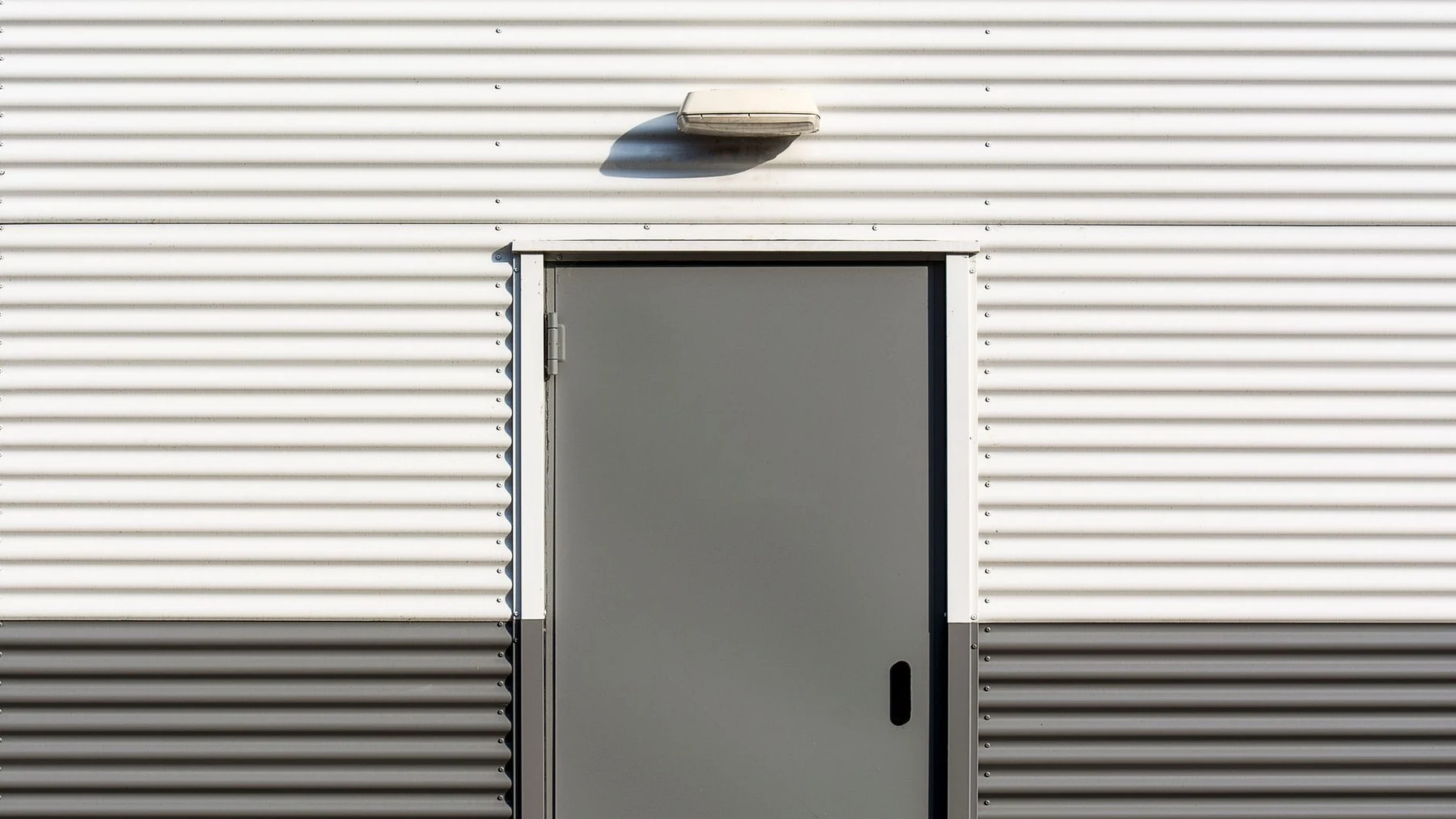
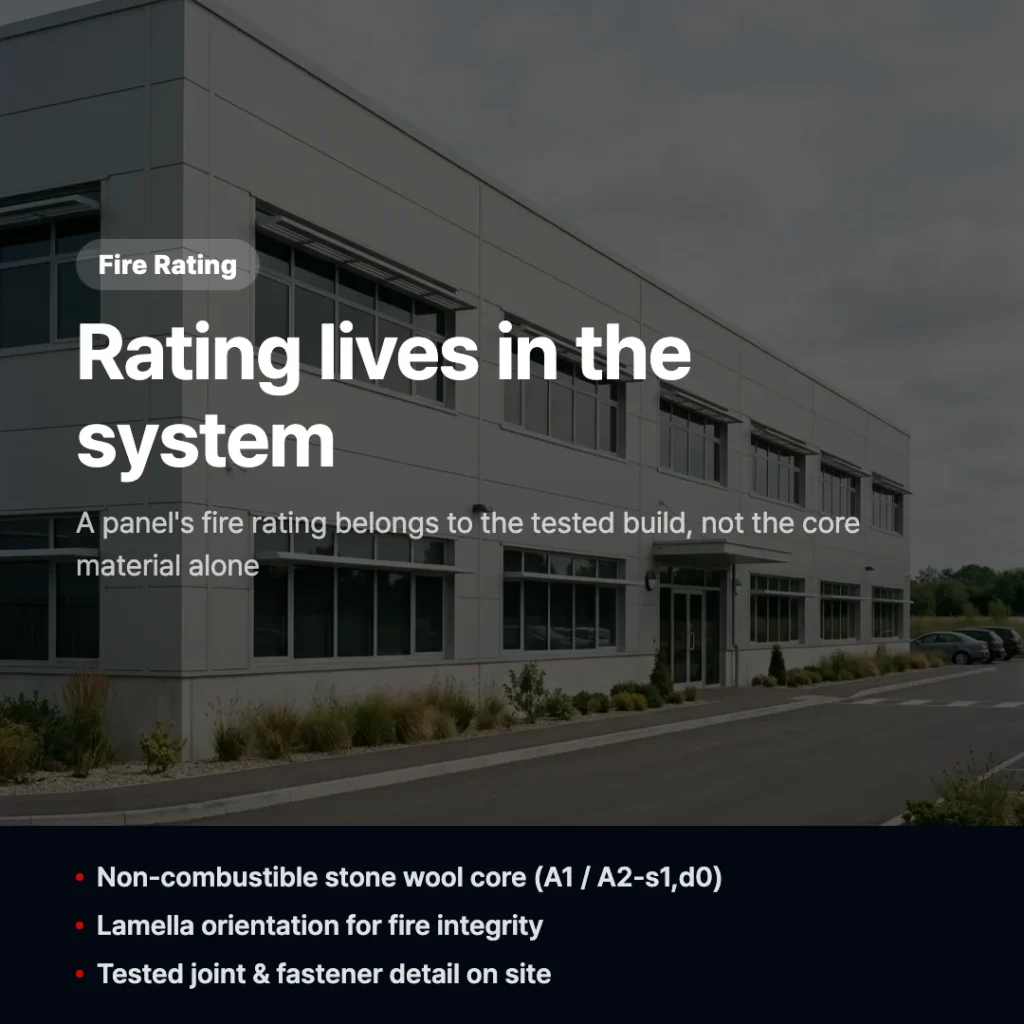
PIR’s fire advantage comes from char formation: when the isocyanurate rings are exposed to heat they build a stable carbon char layer that shields the foam underneath and slows flame spread. PU chars far less and breaks down at lower temperatures, so at the same thickness PIR consistently reaches a higher reaction-to-fire class. This is the single reason most producers move to PIR in the first place.
In European terms, PIR panels reach roughly B-s1,d0 to C-s2,d0 under EN 13501-1, where a PU core of the same build would sit lower. Under Korean testing, PIR can meet quasi-noncombustible certification with total heat release at or below 8 MJ/m² per KS F ISO 5660-1. The comparison is clean: same line, same thickness, better fire class, which is exactly what a tightening building code wants to see.
Line configuration for PIR production
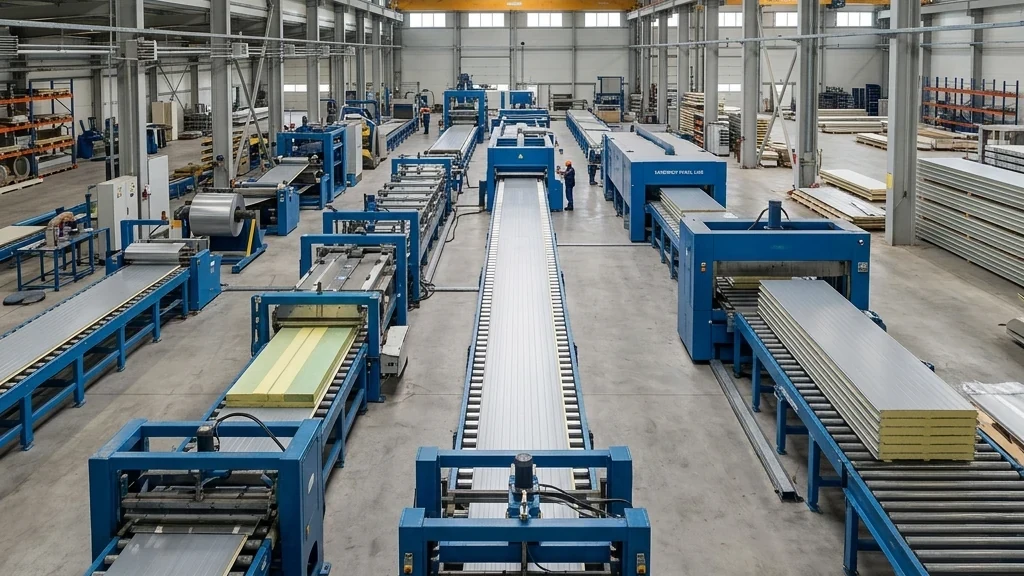
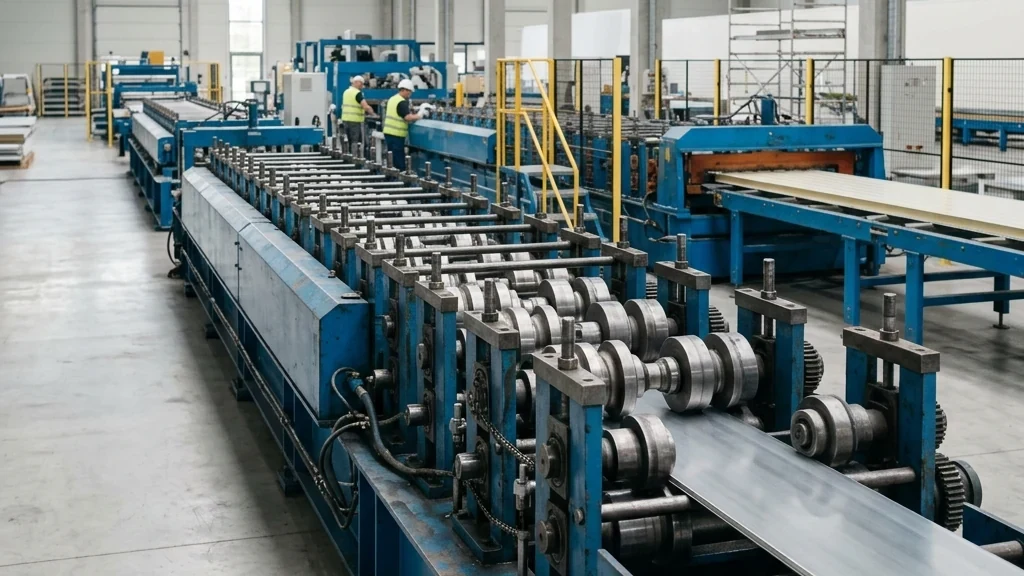
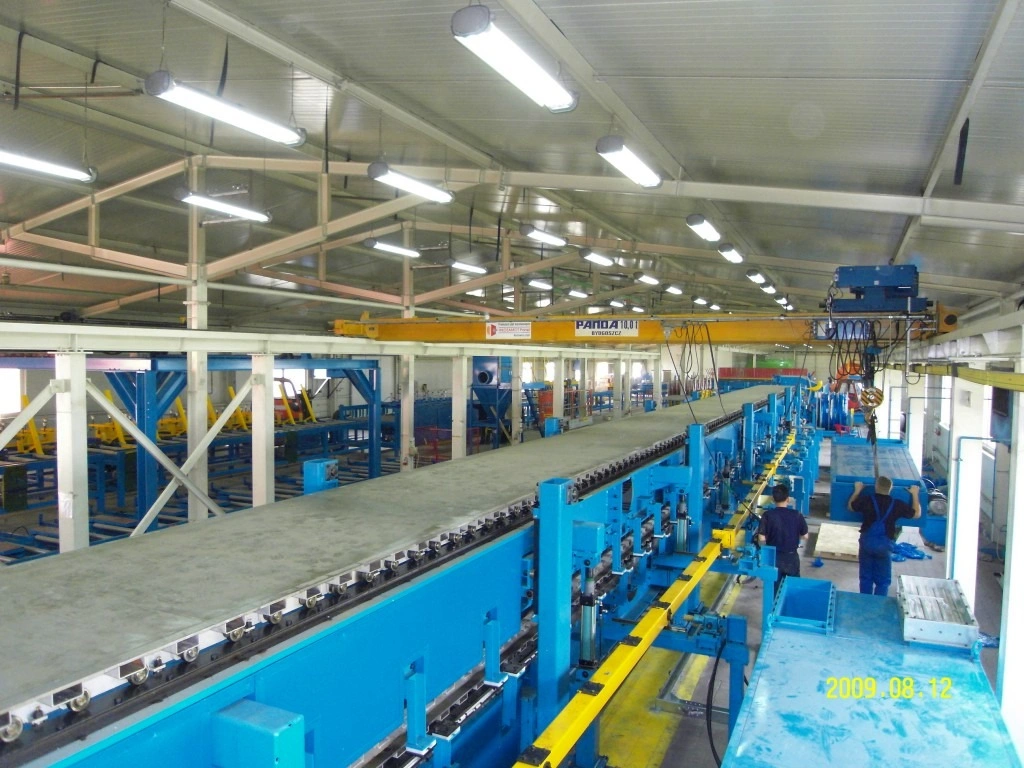
A PIR-capable continuous line is a double-belt laminator with metering, mixing, extended heated curing zones, and a cutting station, tuned so the extra heat for trimerization is available across the cure length. The hardware overlaps heavily with a PU line, but the thermal capacity and control resolution are what make PIR practical rather than just possible.
Typical envelope for a continuous PIR line covers line speeds of 4 to 12 m/min, panel thickness from 30 to 250 mm, and belt width in the 1,000 to 1,250 mm range, with cutting held to about ±1 mm squareness. Because the belt and metering are common to both cores, the same configuration produces PU when the market wants low cost and PIR when it wants fire class. The broader technology context sits in Continuous Sandwich Panel Line: Technology, Benefits & Applications, which frames where PIR fits among panel types.
KINDUS continuous PIR line
At KINDUS, we build continuous PU and PIR panel lines on a single platform, with metering held to ±0.5%, mixing at 120 to 180 bar, and curing zones sized for the higher heat PIR needs. That combination is what lets a producer hold a 200 to 300 isocyanate index steady and hit fire classes reliably rather than by luck.
For a manufacturer facing new fire codes, the value is not a second machine but a second recipe on the machine you already justified. Switchover between PU and PIR runs through formulation and temperature changes, often within about 30 minutes, so one line answers two markets. Explore the full line at Continuous PU/PIR Sandwich Panel Line.
Can a PU line be converted to run PIR?
Usually yes, because PU and PIR share the same continuous line hardware. Conversion is mainly a recipe and thermal change, and a well-built line switches between the two in around 30 minutes, as long as its metering and temperature control can hold PIR’s higher isocyanate index.
What is the isocyanate index?
It is the ratio of isocyanate supplied to the amount needed to fully react with the polyol, shown as a percentage where 100 is an exact balance. PU runs near 100, while PIR runs in the 200 to 300 range so that excess isocyanate trimerizes into the isocyanurate rings that define the foam.
Why does PIR perform better in fire than PU?
When heated, PIR’s isocyanurate rings form a stable char layer that shields the foam and slows flame spread, while PU chars much less and degrades at lower temperatures. At the same thickness PIR therefore reaches a higher reaction-to-fire class, which is why producers move to it as fire codes tighten.