A structurally perfect EPS sandwich panel can still fail in service, and almost always the failure traces back to the bond line rather than the foam or the steel. When a facing sheet lifts at the edge, when a hidden void spreads under load, or when a panel delaminates after a few thermal cycles, the root cause sits in adhesive choice, application, or press control. These are the hardest defects to catch because they are invisible from the outside until the panel is already installed.
In this article, we’ll look at bonding from a practical diagnostic angle: which adhesive systems suit EPS, how to control application and press parameters, and how to trace voids and delamination back to their real causes.

Why bonding decides EPS panel quality
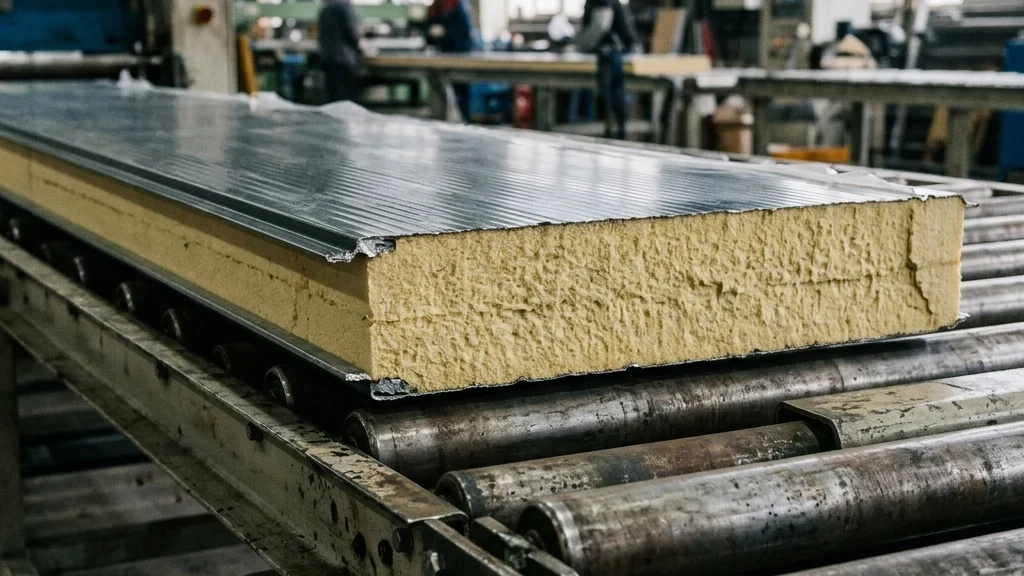
EPS panel bonding is the process of joining metal facing sheets to an expanded polystyrene core using a structural adhesive under controlled pressure, and in EPS construction this bond is the panel’s only structural connection. Unlike PU or mineral wool lines where the core can foam or fuse directly against the facing, EPS is a pre-formed block, so bond quality depends entirely on adhesive selection, surface preparation, application uniformity, and press parameters. A weak bond line does not announce itself on a finished panel that looks flat and clean, which is exactly why it is dangerous.
At KINDUS, we treat the bonding station as the true quality gate of an EPS line rather than a downstream assembly step. Every parameter upstream, from steel cleanliness to foam flatness, exists to give the adhesive a fair chance to perform.
Adhesive systems compared: 1K polyurethane vs 2K epoxy
| Criteria | 1K Polyurethane | 2K Epoxy |
|---|---|---|
| Cure | Ambient moisture | Tight mix ratio |
| Strength | Standard | Higher |
| Process tolerance | Forgiving | Strict |
Structural adhesive for EPS bonding is a formulation that develops load-bearing shear and peel strength across the full panel face, and the two dominant families are one-component polyurethane and epoxy-modified two-component systems. A 1K polyurethane cures with ambient moisture, tolerates minor surface variation, and forgives small mismatches in application, which makes it the practical default for continuous lines running standard building panels. A 2K epoxy-modified adhesive delivers higher rigidity and better performance where thermal or chemical resistance matters, but it demands tighter mixing ratios, cleaner surfaces, and stricter open-time discipline.
The trade-off is process tolerance against ultimate performance. Where a line runs high volume with routine specifications, the moisture-cure forgiveness of 1K polyurethane usually wins. Where the end use pushes strength or environmental demands, 2K epoxy earns its extra handling burden. Two-component polyurethane systems used in EPS bonding typically reach handling strength within 10 to 30 minutes at room temperature, with full cure over 24 hours, so line speed and stacking logistics have to be planned around that window. For a fuller picture of how bonding fits the wider machine, the EPS Sandwich Panel Machine: Technology, Process & Selection Guide walks through each station in sequence.
Application uniformity and open-time control
Application uniformity is the degree to which adhesive is spread at a consistent coat weight across the entire bonding face, and it is the single variable that most often separates a sound panel from a defective one. Uneven coat weight leaves resin-starved zones that never develop full strength and resin-rich zones that waste material and can trap solvent or air. Open time, the interval between applying adhesive and closing the press, has to stay inside the manufacturer window; close too early and you disturb the film, close too late and the adhesive skins over and loses wetting.
A quick check routine on the application station catches most of these before they reach the press:
- Verify coat weight at the sheet edges and center, not just the center
- Confirm roller or spray coverage leaves no dry streaks or beads
- Track ambient temperature and humidity against the adhesive’s rated open time
- Keep the EPS face and metal facing clean and dust-free before coating
- Log the batch and mixing ratio for every 2K run
Does more adhesive give a stronger bond?
No. Beyond the specified coat weight, extra adhesive adds cost and can trap air or gas, which creates the very voids you are trying to avoid. Consistent coverage at the rated weight beats a heavier, uneven film every time.
Press parameters: pressure, dwell time, temperature
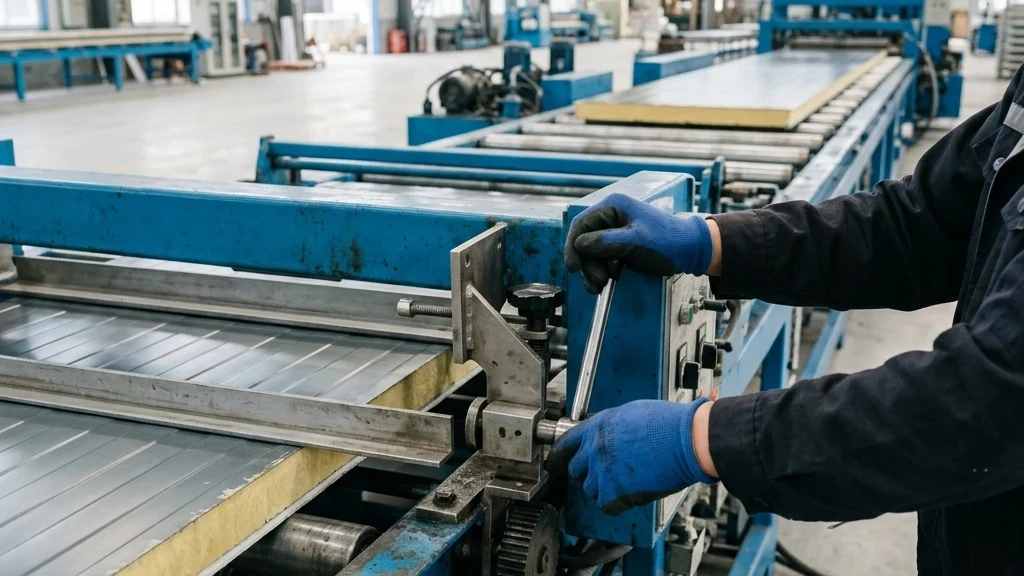
Press parameters are the pressure, contact time, and temperature applied while the adhesive sets, and they convert a coated stack into a bonded panel. Press pressure across the full panel face is typically in the range of 0.01 to 0.05 N/mm² for EPS, which is deliberately gentle: EPS is a low-density core that crushes under excessive load, so the goal is even contact, not high force. Uneven pressure, from a worn platen or a warped foam block, is a direct cause of localized voids because parts of the face never make proper contact.
Dwell time has to match the adhesive’s handling-strength window so the bond holds when the panel moves on. Some systems benefit from mild heat, typically 30 to 50°C at the press contact surface, to accelerate open-time management and curing, but heat is a tool for speed, not a substitute for correct pressure and dwell. The layout of the press and its supporting stations shapes how consistently these parameters hold across a run, and the EPS Sandwich Panel Production Line Layout & Configuration guide covers how the bonding zone is positioned within the full line.
Bond defects — voids and delamination: root cause and fix
A bond defect is a discontinuity in the adhesive layer that reduces load transfer between facing and core, and the two you will meet most are voids and delamination. A void is an unbonded pocket, usually from trapped air, gas from an over-thick film, or a low-contact zone under uneven press pressure. Delamination is the facing separating from the core, most often caused by contaminated surfaces, adhesive applied outside its open time, or insufficient dwell before handling. The difference matters diagnostically: voids point you back to application coverage and press contact, while delamination points to surface prep, open time, and cure timing.
The fix is rarely a single change; it is closing the loop between the defect and the station that produced it. Periodic peel tests and shear tests on finished panels are the mechanism that closes that loop, turning a vague field failure into a specific parameter to correct. The Sandwich Panel Manufacturing Process: Step-by-Step Technical Overview shows where these checks sit in the overall flow.
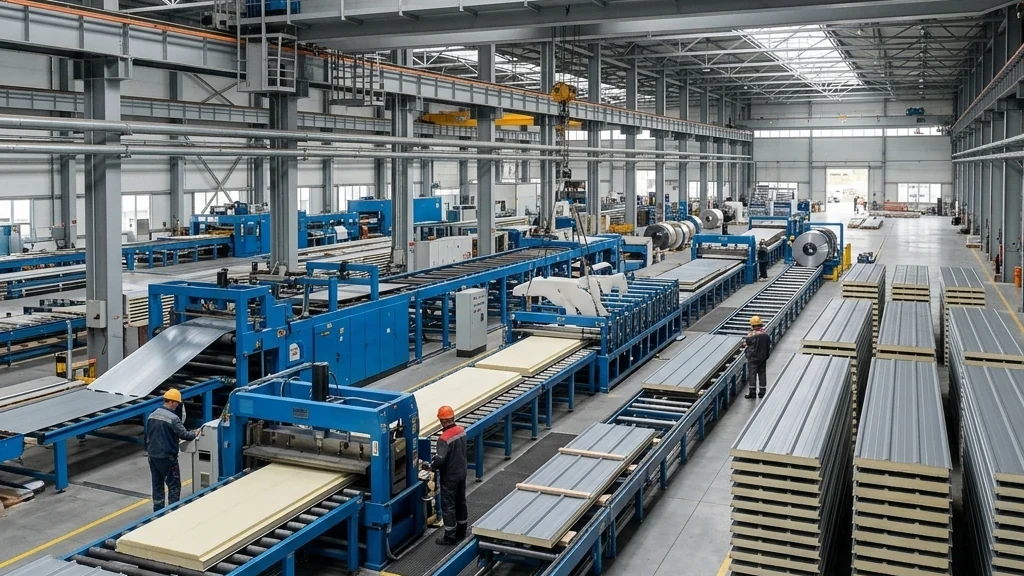
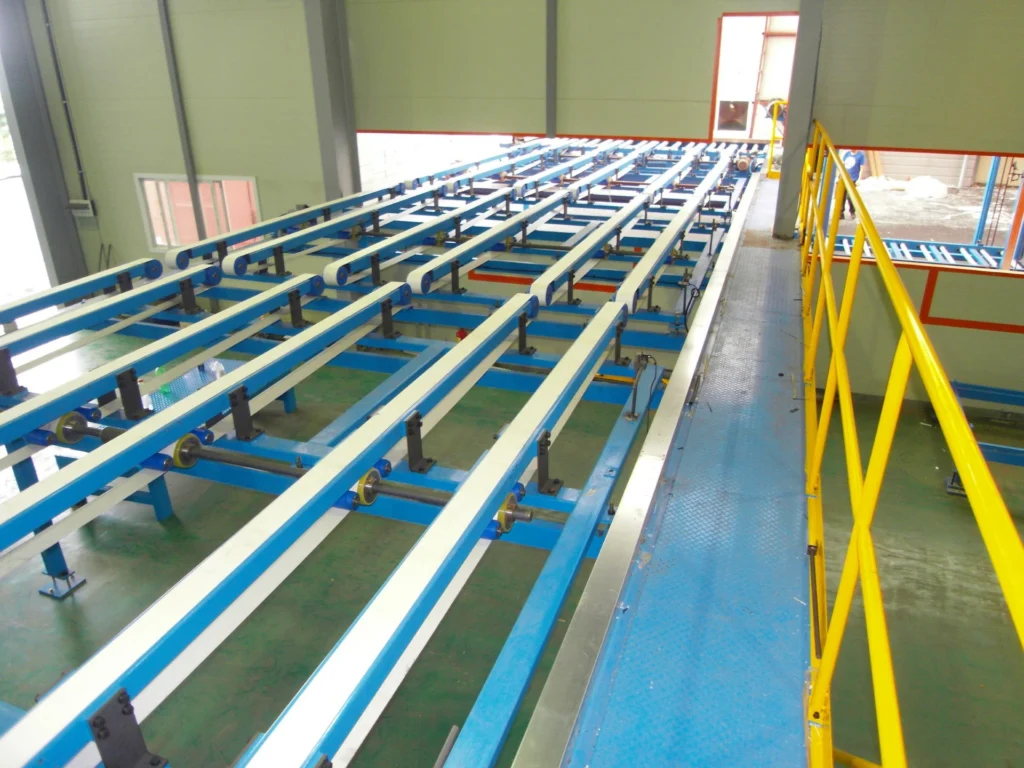
KINDUS EPS bonding line
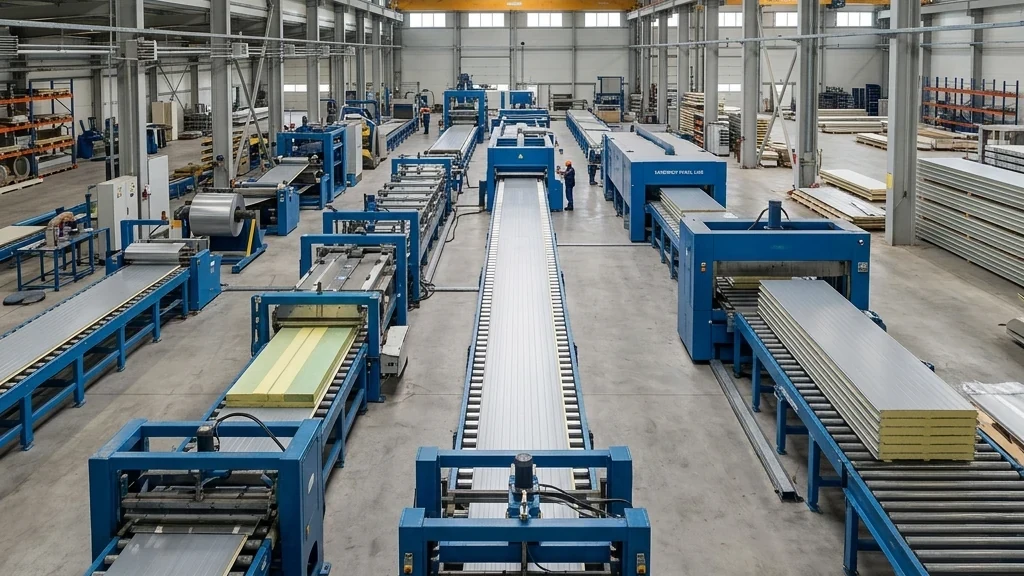
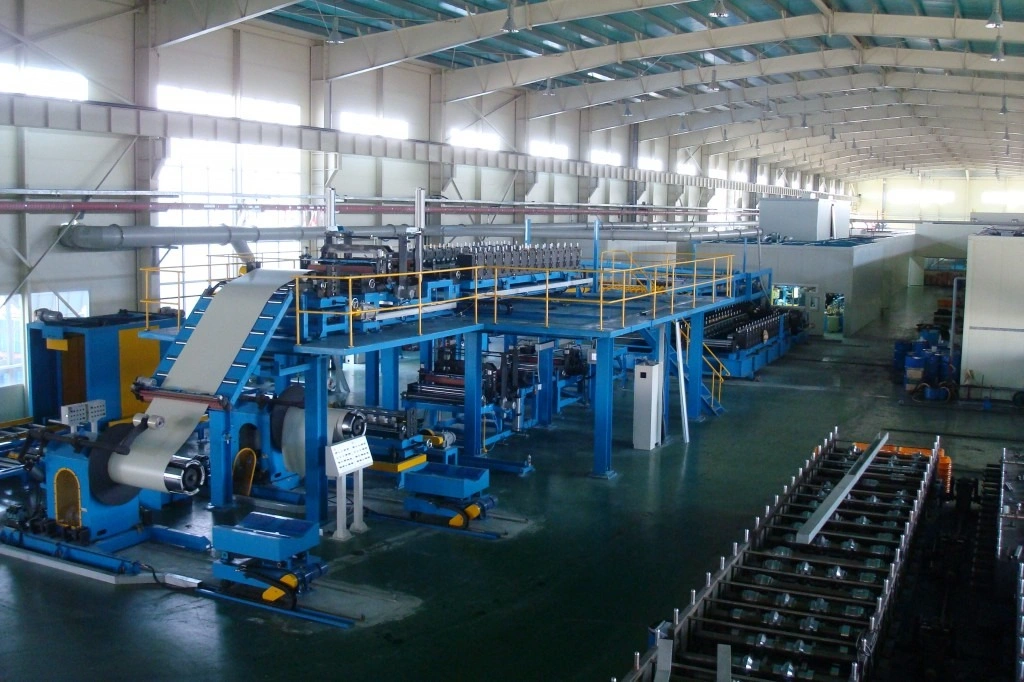
The KINDUS EPS bonding line is a continuous production system that integrates surface preparation, controlled adhesive application, and a press stage tuned to EPS pressure ranges, with quality-test discipline built into the process rather than bolted on afterward. The engineering intent is to make the correct parameters the default and the incorrect ones hard to reach, so consistency does not depend on operator vigilance alone.
See the full EPS line specifications at EPS Sandwich Panel Line.
What is the main cause of bond failure in EPS panels?
Most bond failures come from uneven adhesive application or uneven press pressure, which leave resin-starved zones and low-contact areas that develop into voids or delamination. Contaminated surfaces and adhesive used outside its open time are the other frequent causes.
How do I choose between 1K polyurethane and 2K epoxy?
Choose 1K polyurethane for standard building panels and high-volume lines, where its moisture cure and process tolerance keep production stable. Choose a 2K epoxy-modified system when the end use demands higher rigidity or thermal and chemical resistance, and you can hold the tighter mixing and open-time discipline it requires.
What peel and shear test standard should I use?
Peel and shear tests should be run periodically on finished panels as a core process discipline, sampling across the run rather than a single point. Test acceptance criteria are set by the adhesive and panel specification for the intended application, so align sampling frequency and pass thresholds with your project’s structural requirements and the adhesive manufacturer’s data.