Choosing the wrong supplier for a sandwich panel line is a mistake you live with for years. A production line is a high-capital, multi-year commitment, and the sandwich panel line supplier evaluation that precedes it too often comes down to gut feel, a glossy brochure, or the lowest quoted number. When the equipment underperforms, the throughput never reaches the promised figure, or spare parts take months to arrive, the cost of that intuitive decision compounds across every shift for the life of the plant. The problem is rarely a lack of options. It is the absence of a repeatable method to compare those options on the terms that actually matter.
In this guide, we lay out a structured framework for evaluating a sandwich panel line supplier, from scoring criteria to due diligence and contract terms.

Why a Structured Evaluation Beats Gut Feel
A structured evaluation is a documented, repeatable process that scores every candidate supplier against the same weighted criteria rather than a single impression or price point. The distinction matters because a weighted scoring approach forces you to trade off technical fit, track record, and after-sales support in the open, whereas a single-factor lowest-price decision hides those trade-offs until they surface as downtime. A line that costs less at signing but idles for weeks waiting for a replacement roller is not the cheaper line.
The value of structure is that it survives the people involved. A framework can be shared with engineering, procurement, and finance, defended to a board, and reused on the next investment. It also disciplines the sales conversation: when a supplier knows you are scoring references and commissioning support alongside price, the discussion shifts from discounts to substance. A supplier such as KINDUS, founded in 1995 with more than 170 projects delivered across 40 countries and CE-certified equipment, is the kind of candidate a structured process is designed to surface, because its strengths sit in exactly the categories that gut-feel buying tends to overlook. If you want the reasoning behind supplier selection before you build your own matrix, review the criteria behind choosing a manufacturer.
Build Your Scoring Matrix — Criteria and Weights
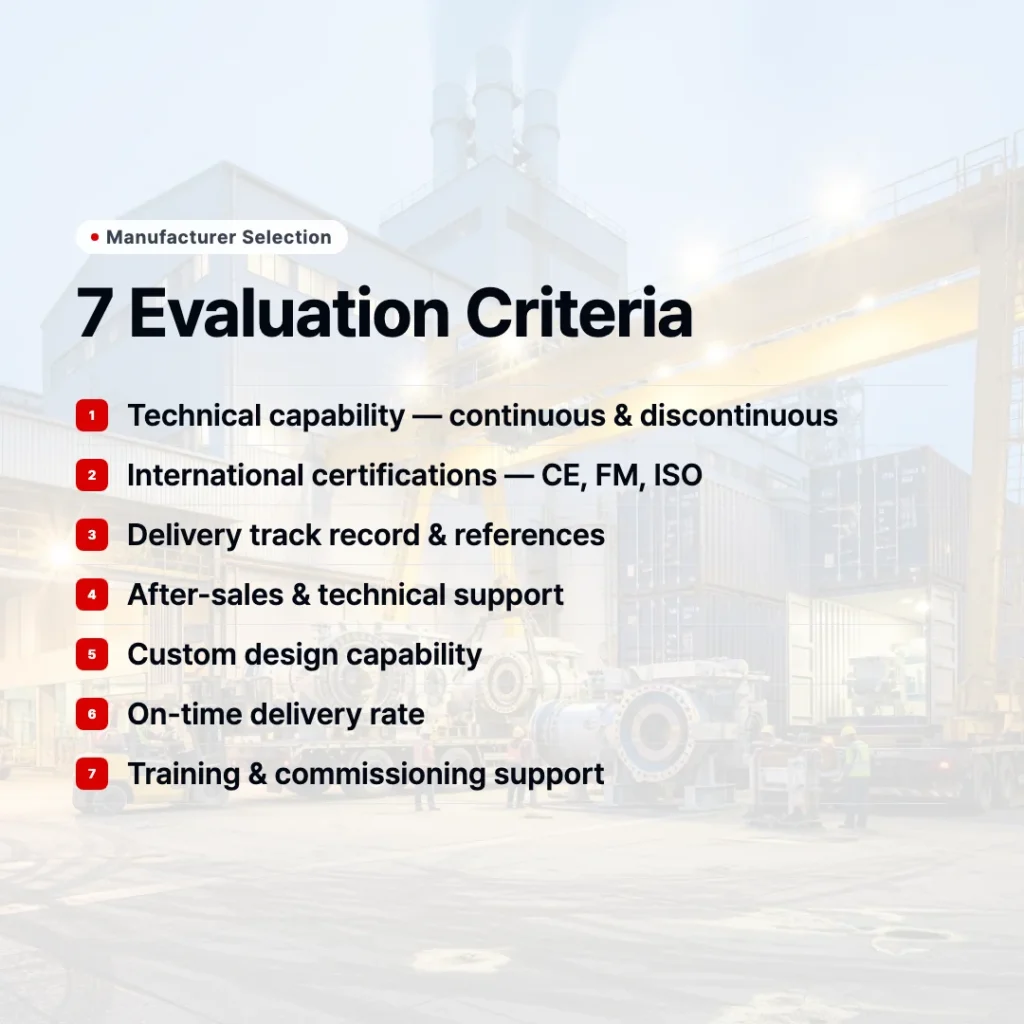
- Technical fit and realistic throughput
- Certifications: CE and your market’s
- References and track record across regions
- After-sales and spare-parts lead time
- Installation, commissioning and training
- Total cost of ownership and warranty
A scoring matrix is a table that lists your evaluation criteria, assigns each a weight reflecting its importance, and rates every supplier on a common scale so that a single comparable score emerges. Building one starts with agreeing the criteria that map to your plant’s realities, then weighting them so that the factors carrying the most operational risk pull the most influence.
The criteria below are the industry-standard set most buyers should weigh, adjusting the emphasis to their own capacity targets and budget:
- Technical fit — whether the line handles your panel types, core materials, thicknesses, and finishing requirements
- Capacity and throughput — the realistic production speed and output against your business plan, not the peak figure in the brochure
- Certifications — CE marking and other compliance relevant to your market and installation region
- References and track record — years in operation, number of comparable projects delivered, and geographic reach
- After-sales and spare parts — availability, lead time, and pricing of consumables and critical components
- Installation and commissioning support — on-site setup, operator training, and ramp-up assistance
- Lead time — from order to a running line, and how it fits your project schedule
- Total cost of ownership — purchase price plus energy, maintenance, spares, and downtime over the equipment’s life
- Warranty — coverage scope and duration on core mechanical and control systems
Weight these to your situation. A buyer under schedule pressure raises the weight on lead time and commissioning; a buyer in a remote region raises spare parts and after-sales. Rate each supplier on a consistent scale, multiply by the weights, and total the scores. The output is not a verdict on its own, but it turns a sprawling comparison into a defensible shortlist. Because throughput and technical fit hinge on the configuration you are buying, it helps to be clear on understanding the line types you are specifying before you finalize the weights.
RFQ and Technical Due Diligence
Technical due diligence is the process of verifying that a supplier’s claimed capabilities hold up against documented evidence rather than sales assertions. It begins with a request for quotation precise enough that every supplier answers the same questions, which is what makes their responses comparable in the first place. A vague RFQ yields vague quotes and an impossible comparison; a detailed one exposes who understands your requirement and who is guessing.
Send an RFQ that specifies your panel types and dimensions, target throughput, core materials, degree of automation, and site conditions, and ask each supplier to state their assumptions explicitly. Then verify the answers. Request line specifications, electrical and mechanical documentation, and evidence of certifications rather than accepting a claim of CE compliance at face value. Ask how throughput figures were measured and under what panel and material conditions, since a headline speed on one product rarely holds across your full range. Clarify what the quoted scope includes and excludes: foundation work, utilities, integration with upstream and downstream equipment, and control system access all tend to sit in the gaps between quotes. Due diligence at this stage is inseparable from the broader plant plan, so weigh each quote against the wider factory planning picture rather than in isolation.
Factory Audit and Reference Checks
A factory audit is a direct inspection of a supplier’s manufacturing capability, and a reference check is structured contact with their existing customers to confirm that delivered lines perform as promised. Together they are the strongest evidence available, because they replace what a supplier says about itself with what its facility and its buyers demonstrate. A shortlisted supplier that welcomes an audit and offers reachable references is signalling confidence; one that deflects both is signalling the opposite.
During a factory visit, look at build quality, in-house engineering and machining capability, quality-control practices, and whether lines resembling yours are actually being assembled on the floor. When you speak to references, focus the conversation on the questions a brochure never answers:
- Did the delivered throughput and quality match what was quoted
- How did installation and commissioning go, and did it run to schedule
- How responsive is after-sales support, and how quickly do spare parts arrive
- Would they buy from this supplier again
Prioritize references operating in conditions close to your own, and give weight to suppliers whose track record spans many projects and regions, since breadth across markets is hard to fake and reflects repeated commissioning under varied conditions.
Red Flags and Contract, Warranty, and After-Sales Terms
Contract and warranty terms are the written commitments that convert a supplier’s promises into enforceable obligations, and red flags are the warning signs that those promises may not hold. This is where a strong evaluation either lands or leaks away, because a high score on the matrix means little if the contract leaves throughput, timelines, and support undefined.
Watch for reluctance to put performance figures in writing, quotes far below the field with no explanation, vague or unusually short warranties, no clear spare-parts commitment, and pressure to sign quickly. Any single sign warrants a closer look; several together are reason to step back. In the contract itself, pin down the performance guarantee with measurable acceptance criteria and a test protocol, the delivery and commissioning schedule with defined milestones, the warranty scope and duration on core mechanical and control components, and a spare-parts and after-sales agreement covering availability, lead times, and pricing. Payment terms should track real milestones such as acceptance testing rather than front-loading risk onto you before the line proves out. A supplier operating for decades with an international project record, as KINDUS has since 1995 across 40 countries, is more likely to stand behind these commitments simply because it intends to be reachable for the next order, but the terms still belong in writing, not in trust.
Frequently Asked Questions
What is the single most important criterion when evaluating a sandwich panel line supplier?
There is no single most important criterion, which is the reason a weighted matrix exists. Technical fit and throughput determine whether the line can do the job, while references, after-sales support, and warranty determine whether it keeps doing it. The right weighting depends on your capacity targets, schedule, and location, so the discipline is in balancing these factors rather than elevating one.
Is a factory audit really necessary, or are references enough?
References and a factory audit answer different questions and work best together. References tell you how delivered lines have performed for real buyers, while an audit shows the manufacturing and engineering capability behind those lines firsthand. For a high-capital commitment, seeing the facility and speaking to customers gives you evidence that neither a quote nor a brochure can provide.
How should we handle a quote that is far cheaper than the others?
Treat a large price gap as a question to investigate, not a saving to bank. Compare the scope line by line, because the cheaper quote often excludes commissioning, integration, spare parts, or a meaningful warranty. Once the scope and total cost of ownership are matched fairly, the real gap is usually much smaller, and sometimes it reverses.
Planning a line investment and want a supplier that meets these criteria?