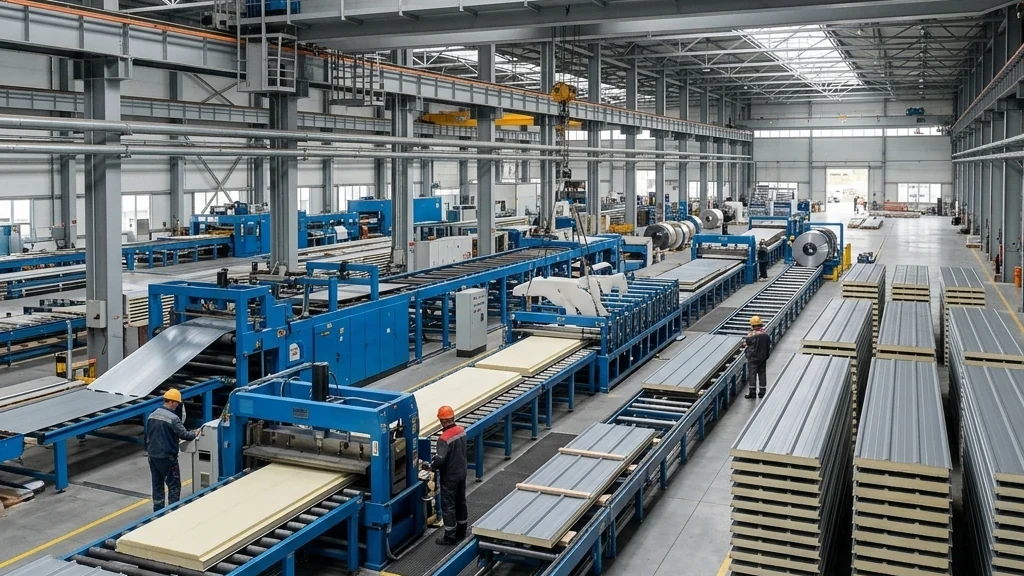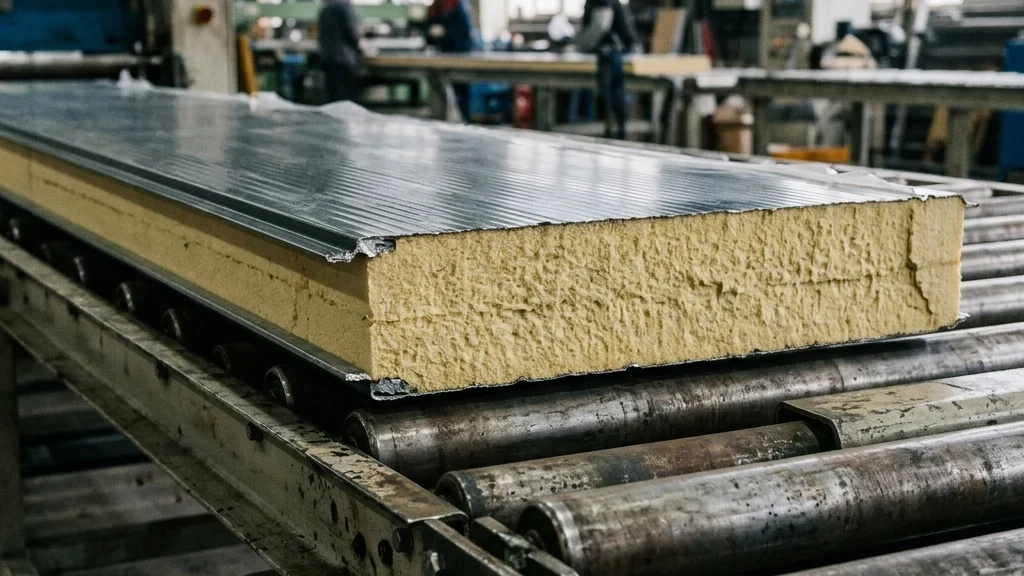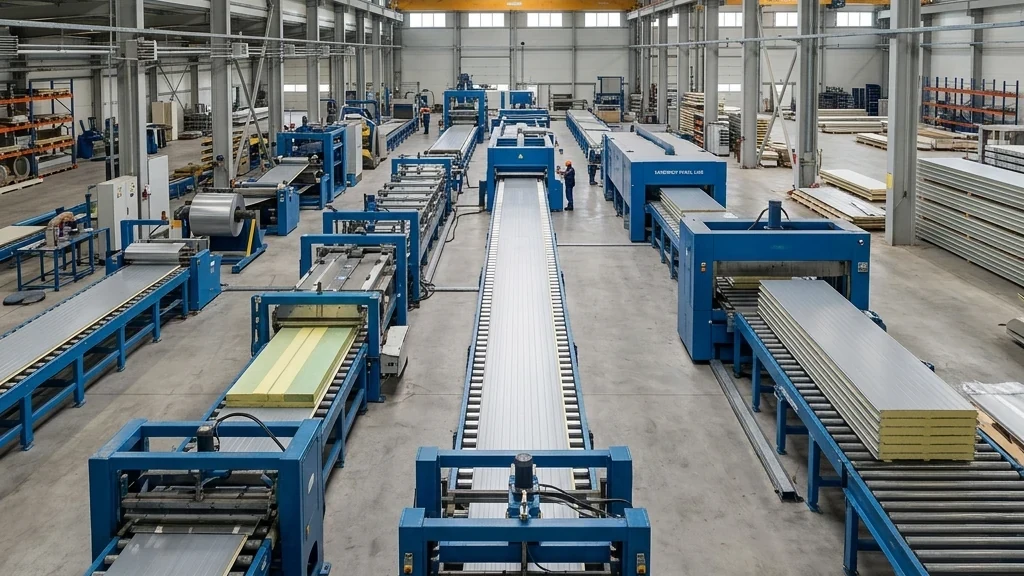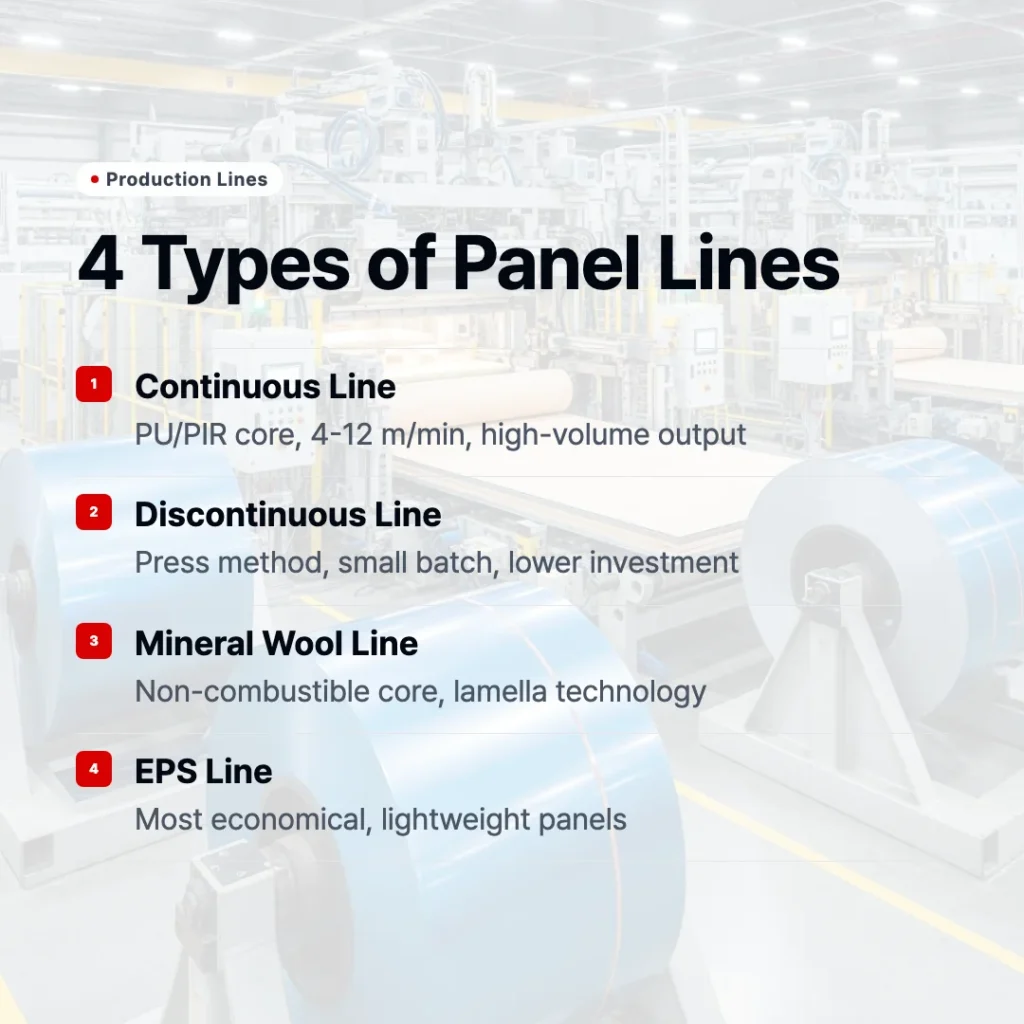
In this article, we will explore the complete sandwich panel manufacturing process — from raw material preparation through to final packaging — covering all three major core material types: polyurethane (PU), mineral wool (MW), and expanded polystyrene (EPS).
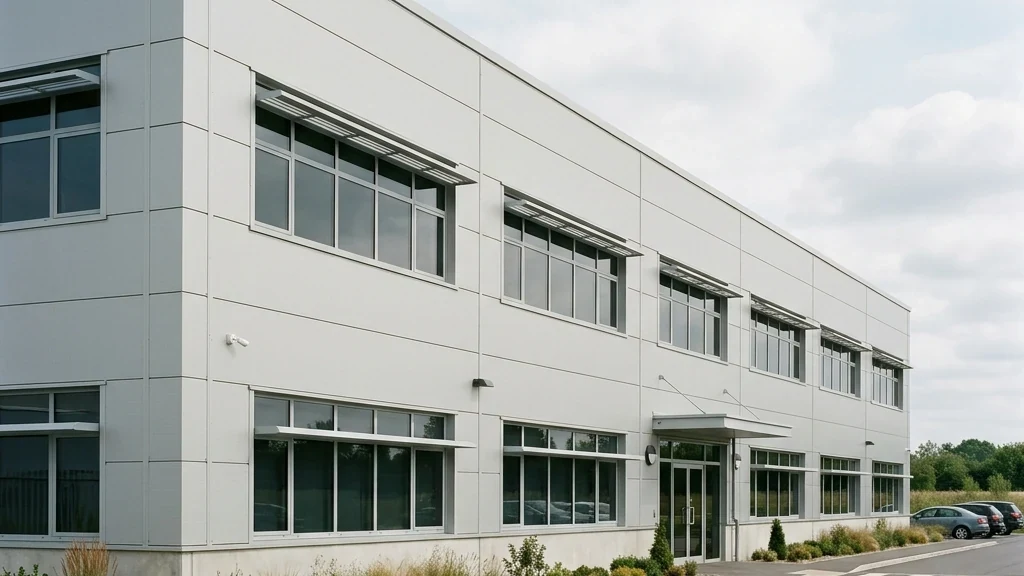
Sandwich panels are composite building elements consisting of two thin metal face sheets bonded to a lightweight insulating core. They are widely used in industrial buildings, cold storage facilities, clean rooms, and prefabricated construction because they combine structural strength with thermal and acoustic performance in a single factory-produced unit. Understanding how these panels are made — and how production parameters differ by core material — is essential knowledge for engineers, project owners, and procurement teams selecting a manufacturing line.
Raw Material Preparation and Feeding
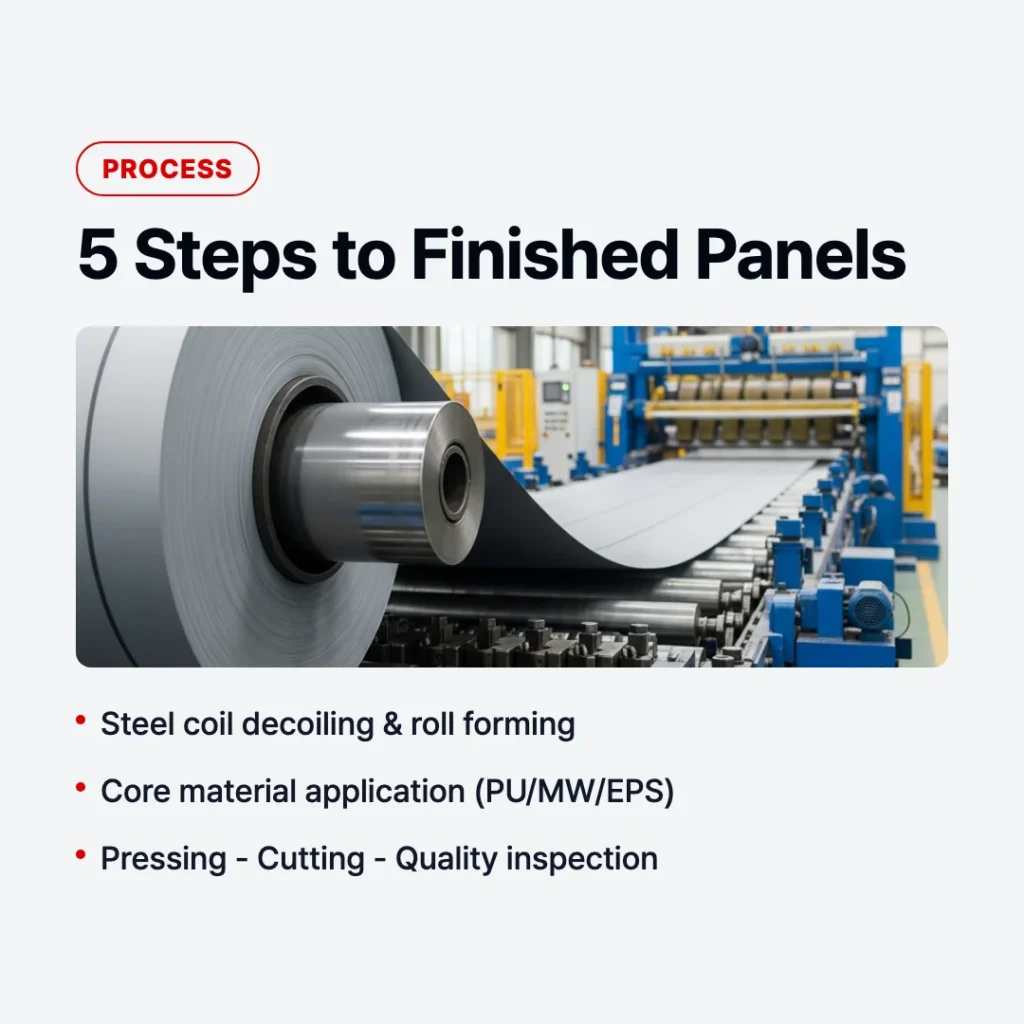
Every sandwich panel begins with two essential inputs: the metal face sheets and the core insulation material. Preparation of both must be handled precisely before they enter the main forming section of the line.
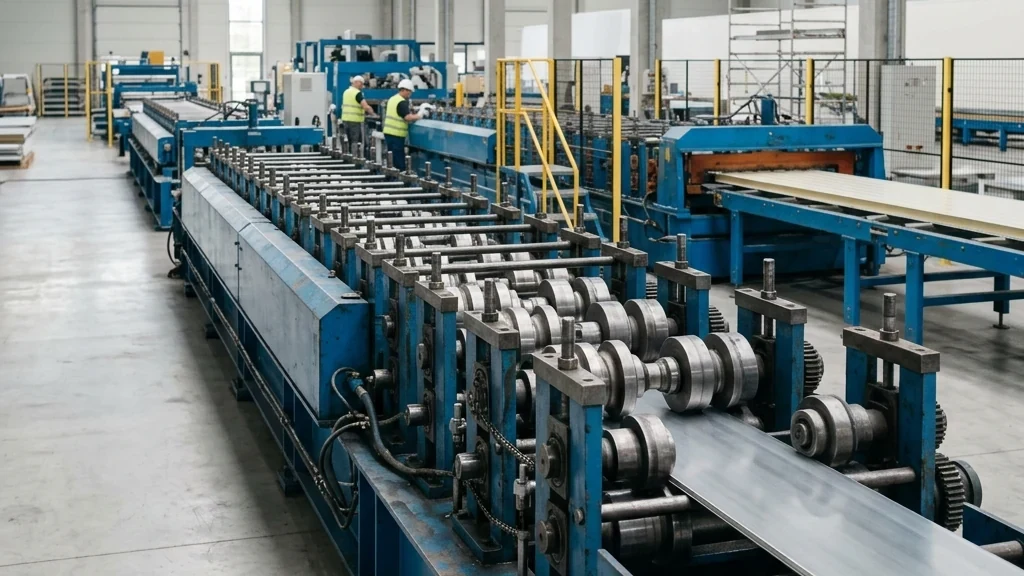
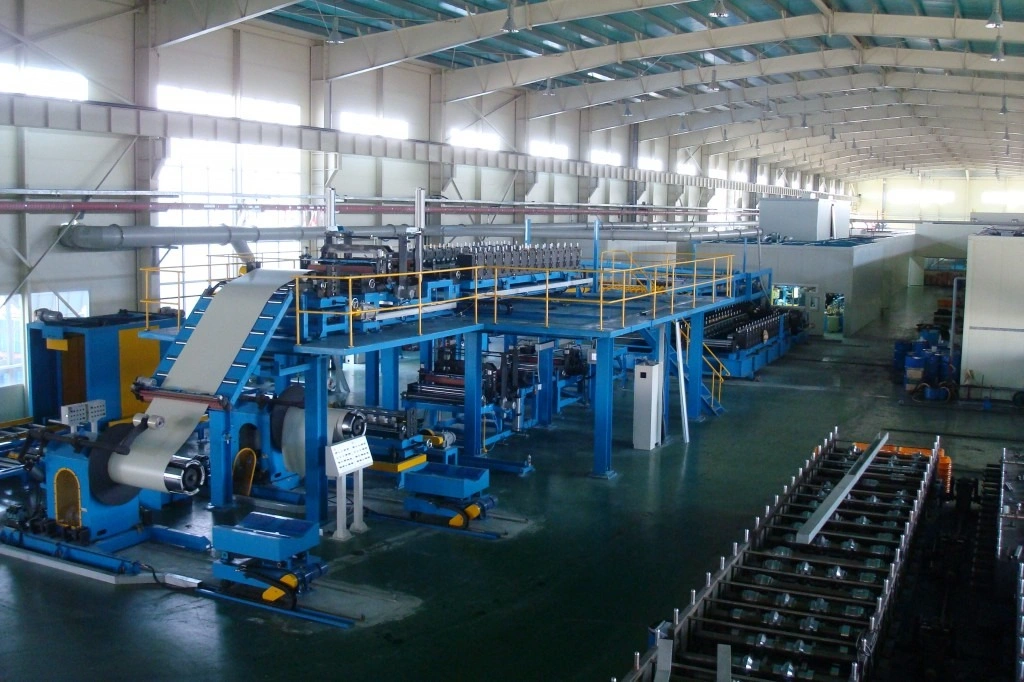
Steel coils — typically pre-painted galvanized steel or aluminum — are loaded onto decoilers at the entry stations. Dual decoilers are standard on modern lines, allowing one coil to feed while the other is prepared for changeover, minimizing downtime. The strip passes through a straightening and cleaning unit that removes surface oils, dust, and oxidation. This cleaning stage is critical because surface contamination directly reduces adhesion between the metal face and the core material.
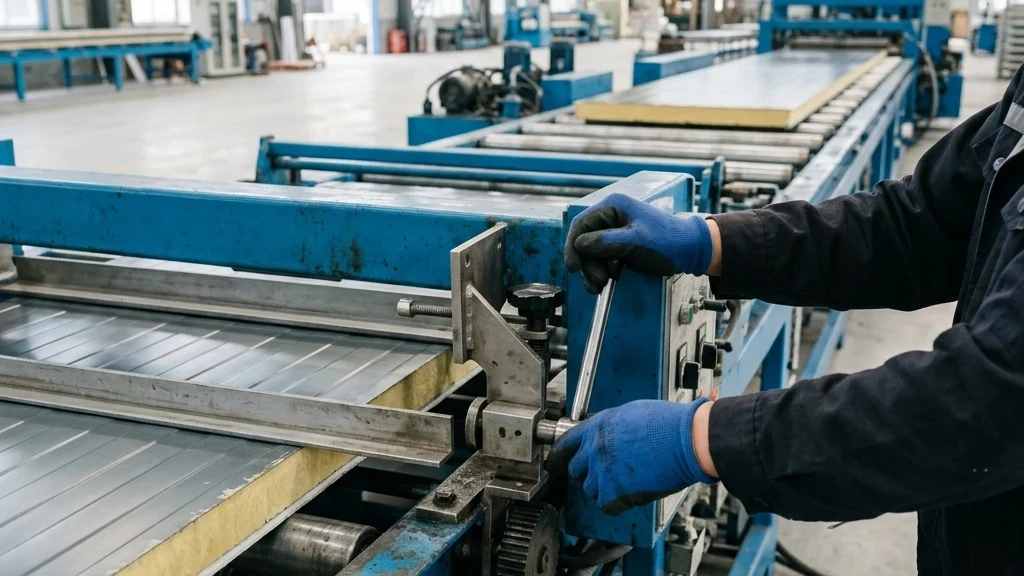
After cleaning, the steel strip enters the roll-forming section. A series of progressive forming rolls shape the flat strip into the desired profile — flat, micro-ribbed, or trapezoidal — which adds stiffness to the finished panel. Top and bottom face sheets are often formed to different profiles depending on the structural and aesthetic requirements of the application.
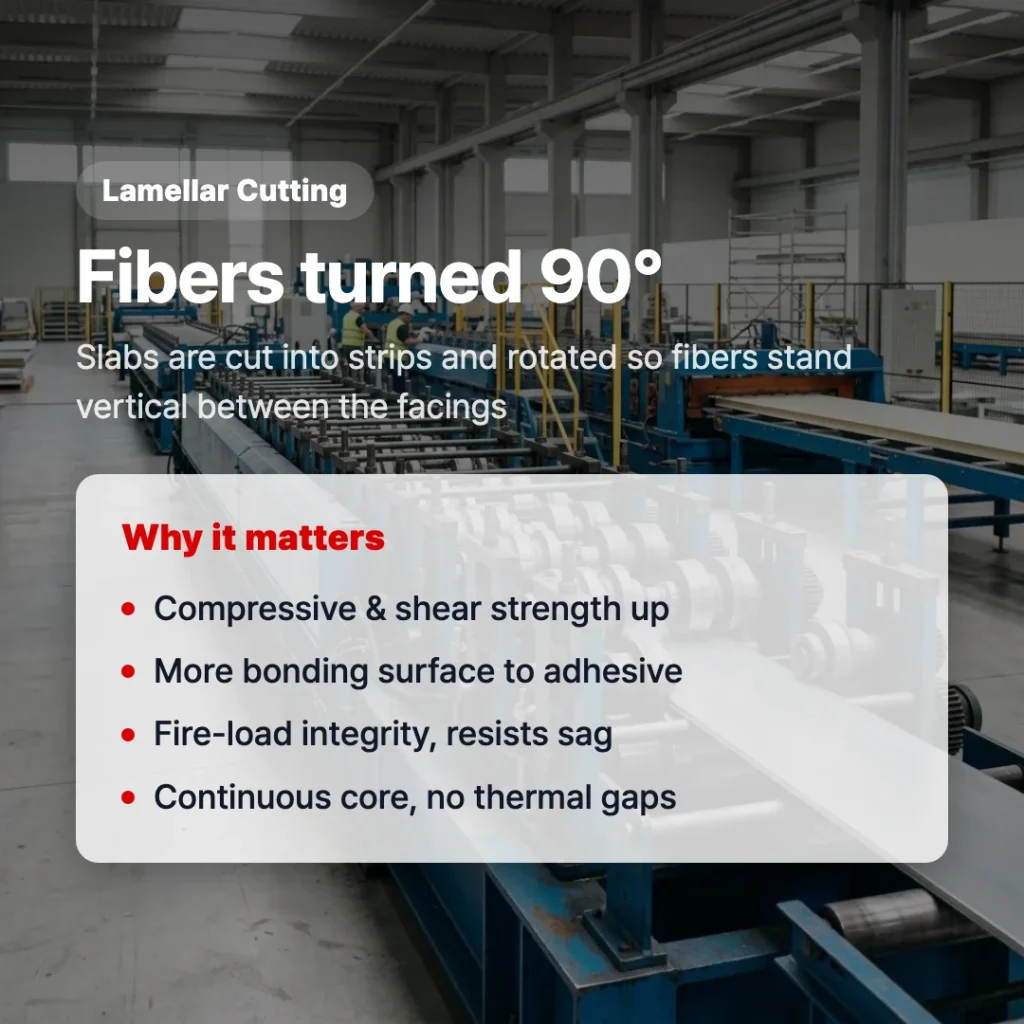
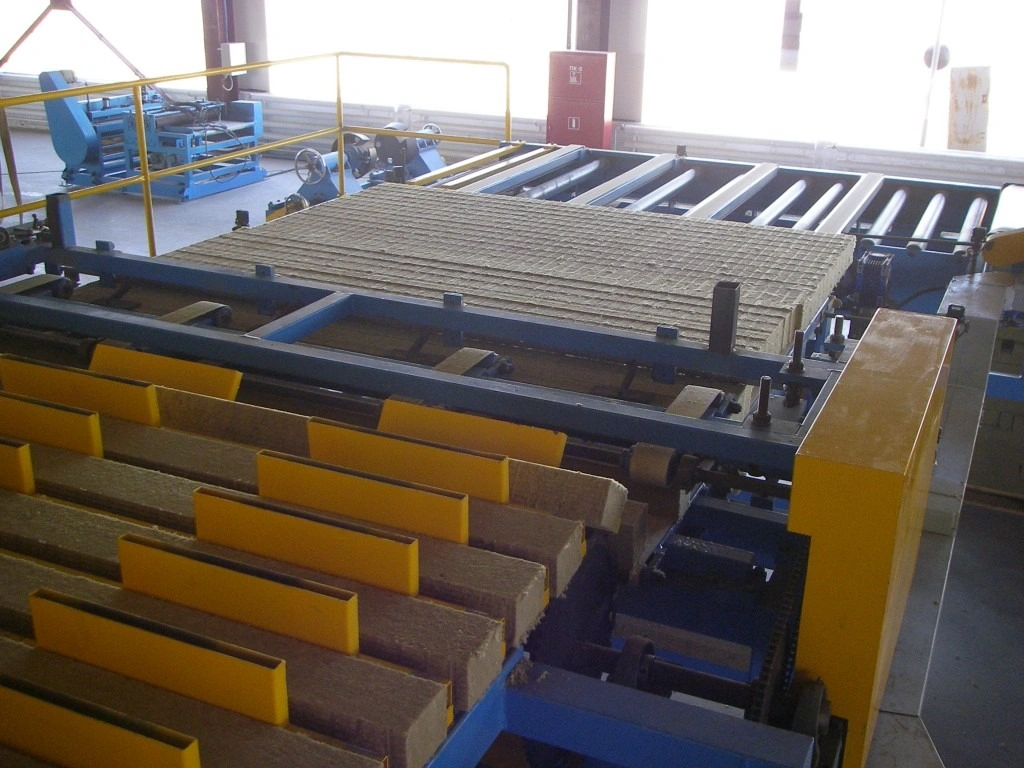
Core material staging differs significantly by type. For PU and PIR panels, the chemical components — polyol and isocyanate — are stored in temperature-controlled tanks on the side of the line. Precise temperature management at this stage (typically 18–22°C for polyol and isocyanate) is essential because chemical viscosity directly affects mixing quality and foam cell structure. For mineral wool panels, rolls or bales of rock wool are fed to a lamellar cutting station where slabs are cut and oriented perpendicular to the panel face to maximize compressive strength. For EPS panels, pre-expanded polystyrene blocks are staged upstream and fed as solid billets into the bonding section.
Core Material Application Process
The core application stage is where the three manufacturing paths diverge most sharply. The machinery, process parameters, and bonding mechanisms are fundamentally different for each insulation type, and understanding these differences helps engineers match the right line configuration to the intended product mix.
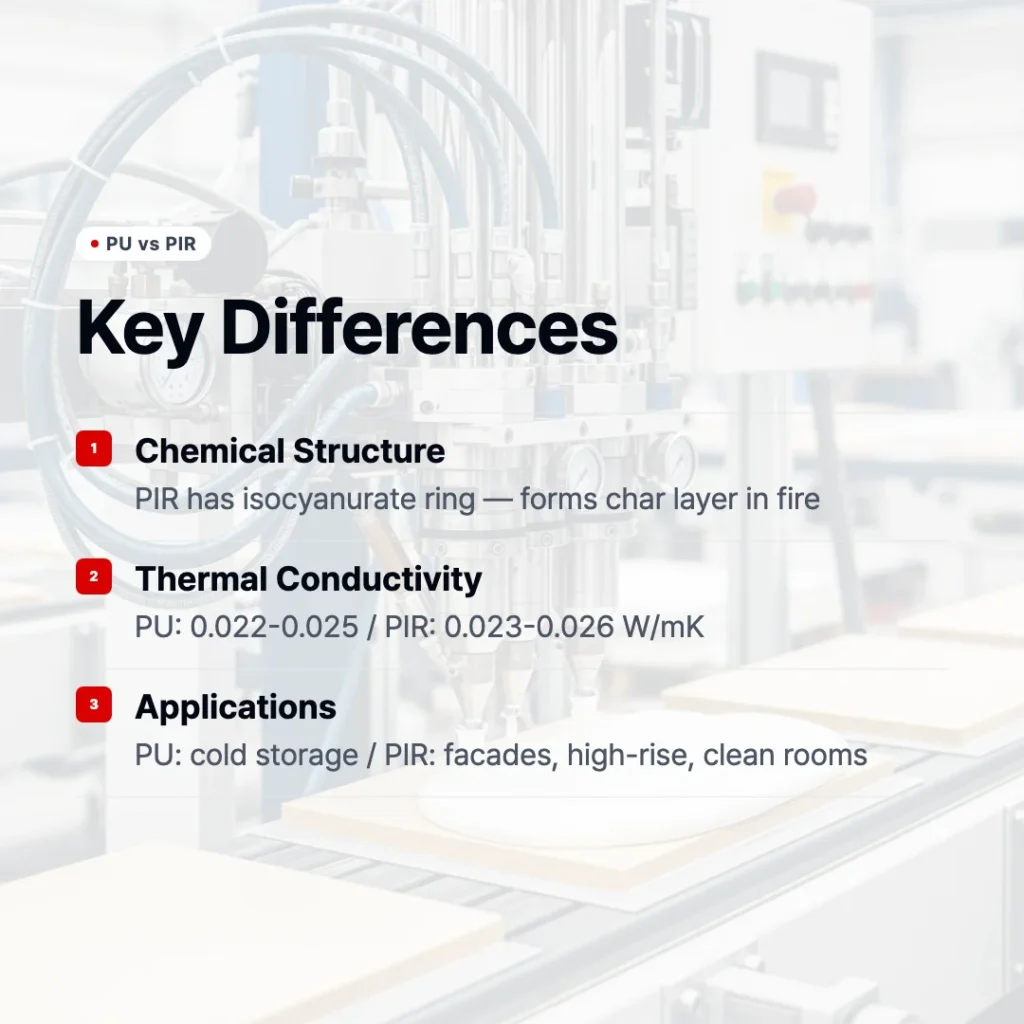
For PU and PIR sandwich panels, the core is applied as a liquid chemical system. A high-pressure mixing head — operating at pressures of 100–200 bar — combines polyol and isocyanate in precise ratios, typically between 1:1 and 1:1.2 by weight depending on the formulation. The mixed liquid is poured or distributed across the moving lower face sheet through a traversing pour head or a fixed multi-point distribution system. Within seconds, the chemical reaction begins: the mixture expands, rises, and crosslinks into a rigid closed-cell foam that bonds chemically to both metal faces. The exothermic reaction and foam rise must be carefully matched to line speed and press gap settings.
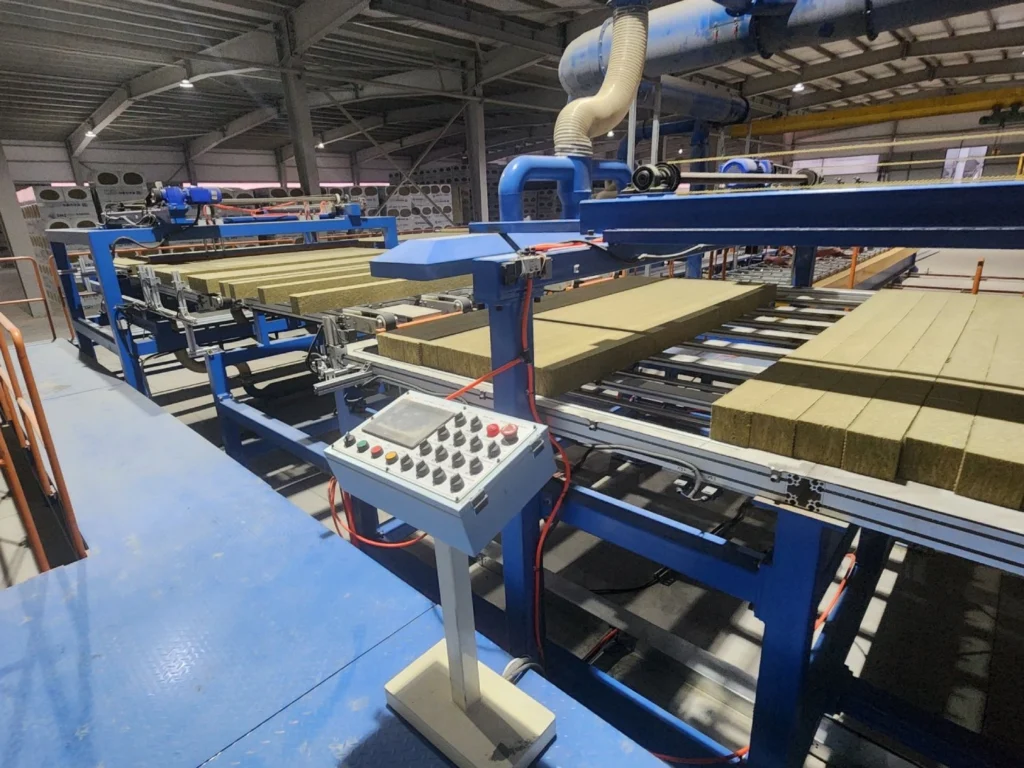
For mineral wool (rock wool) panels, the process is mechanically different. Mineral wool is a non-reactive material, so bonding relies on adhesive rather than chemical fusion. Rock wool slabs are cut to panel width and, in lamellar-cut configurations, rotated 90° so that the fibers run perpendicular to the panel face. This lamellar orientation is important: it increases compressive strength and fire resistance compared to parallel-fiber orientation. A two-component adhesive is applied to both the inner face sheet surfaces and the wool slab surfaces using roller or spray application systems. The wool is then placed between the face sheets and conveyed into the press section. Adhesive cure time and press dwell time must be coordinated to ensure adequate bond strength before the panel exits the press.
For EPS panels, pre-expanded polystyrene blocks are fed between the face sheets. Because EPS is also non-reactive, adhesive bonding is required. One-component polyurethane adhesives or two-component epoxy systems are applied to the face sheet inner surfaces and the EPS block surfaces. EPS is more dimensionally variable than mineral wool slabs, so precise block thickness control and feed alignment are necessary to avoid panel thickness variation.
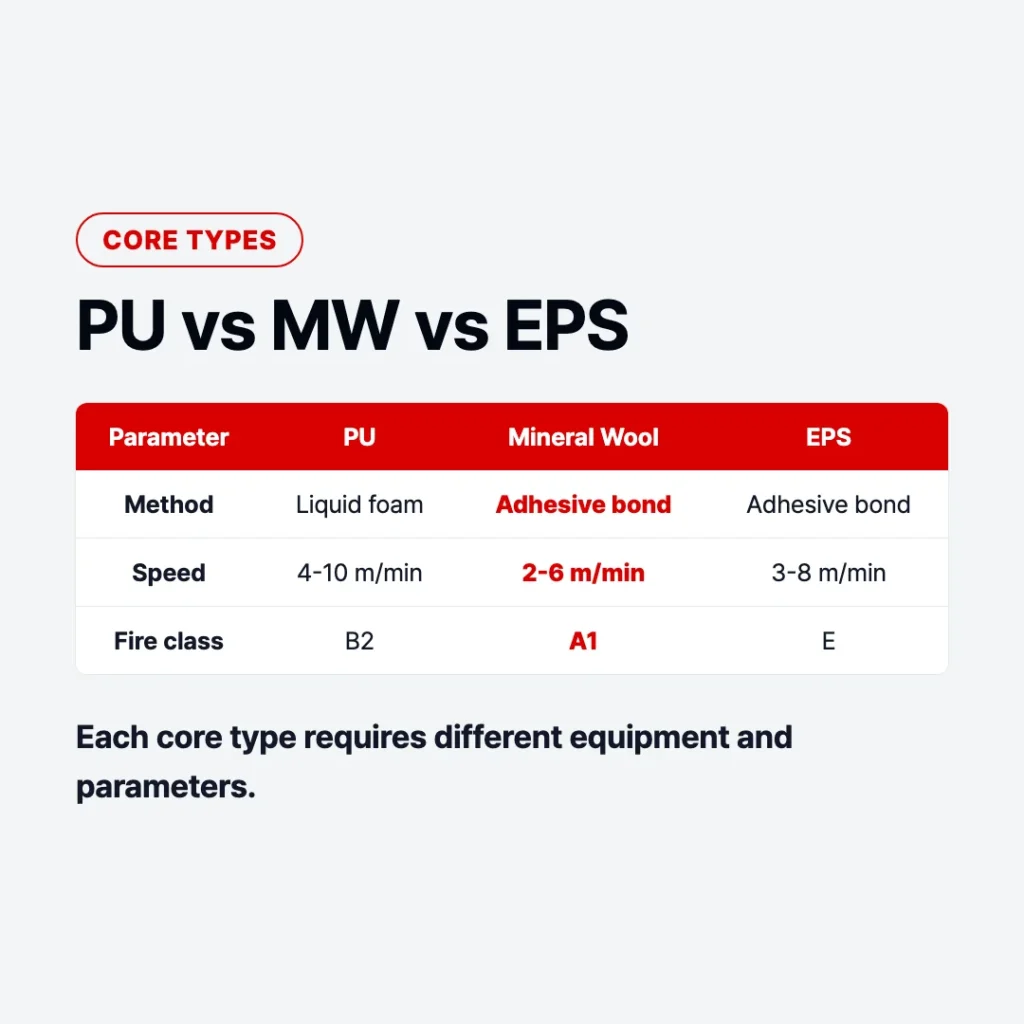
The table below summarizes key differences across the three core application methods:
| Parameter | PU / PIR | Mineral Wool | EPS |
|---|---|---|---|
| Application method | Liquid pour (reactive) | Solid slab + adhesive | Solid block + adhesive |
| Bonding mechanism | Chemical adhesion (foam rise) | Mechanical + adhesive | Adhesive |
| Core orientation control | N/A (poured) | Lamellar cut critical | Block alignment critical |
| Line speed (typical) | 4–10 m/min | 2–6 m/min | 3–8 m/min |
| Fire performance | B2 / PIR improves to B1 | A1 (non-combustible) | E (standard EPS) |
| Thermal conductivity (λ) | 0.022–0.028 W/mK | 0.033–0.040 W/mK | 0.032–0.038 W/mK |
| Typical thickness range | 30–200 mm | 40–200 mm | 50–200 mm |
KINDUS designs its mixing and distribution systems with material-specific calibration protocols, ensuring that each core type is processed within its optimal parameter envelope from the first panel of a production run.
Learn more about continuous line technology: Continuous Sandwich Panel Line: Technology, Benefits & Applications
Panel Forming and Pressing Stages
After core material application, the panel assembly enters the pressing and forming section. This is where the sandwich structure is consolidated — face sheets are pressed against the core under controlled temperature and pressure, and the panel achieves its final thickness, flatness, and bond integrity.
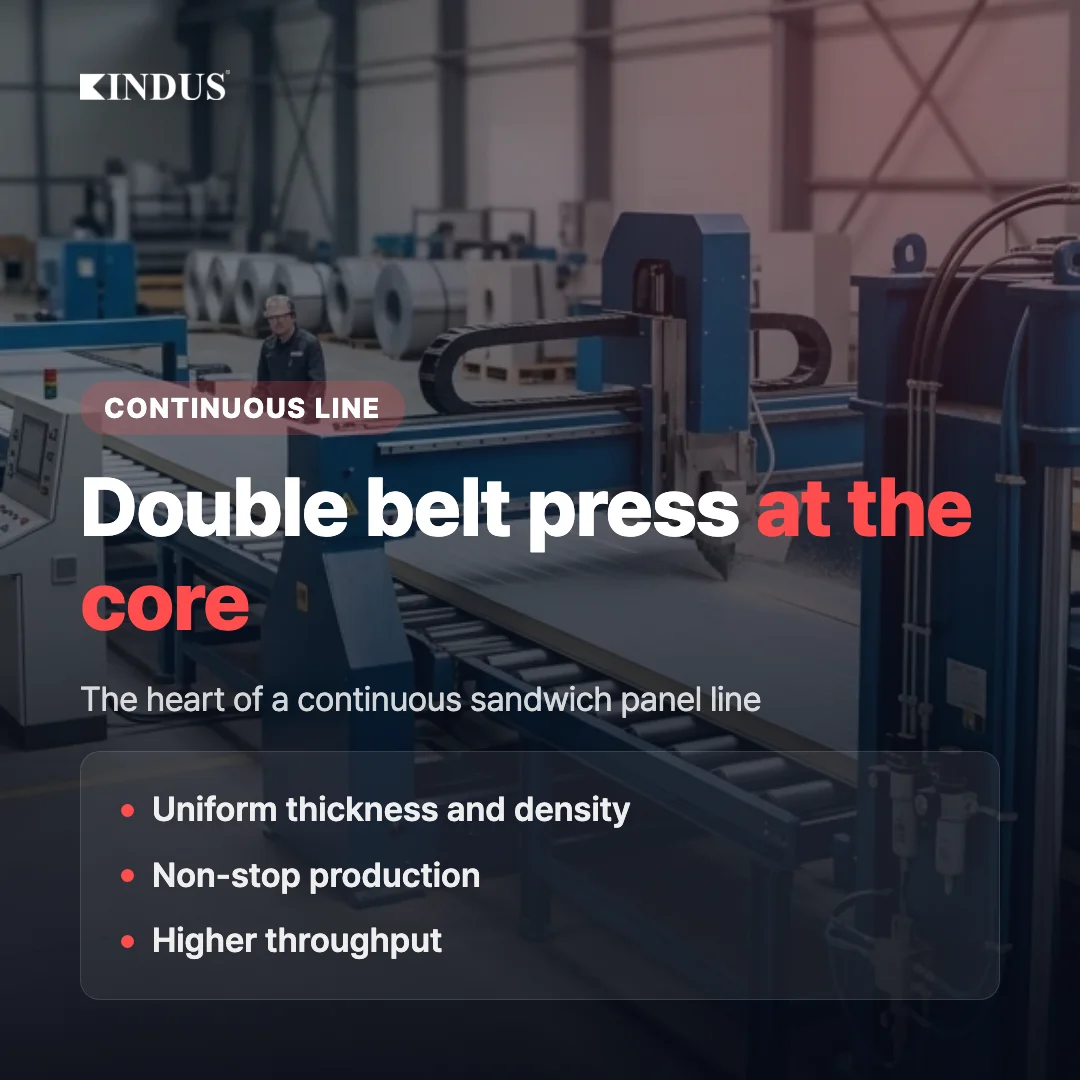
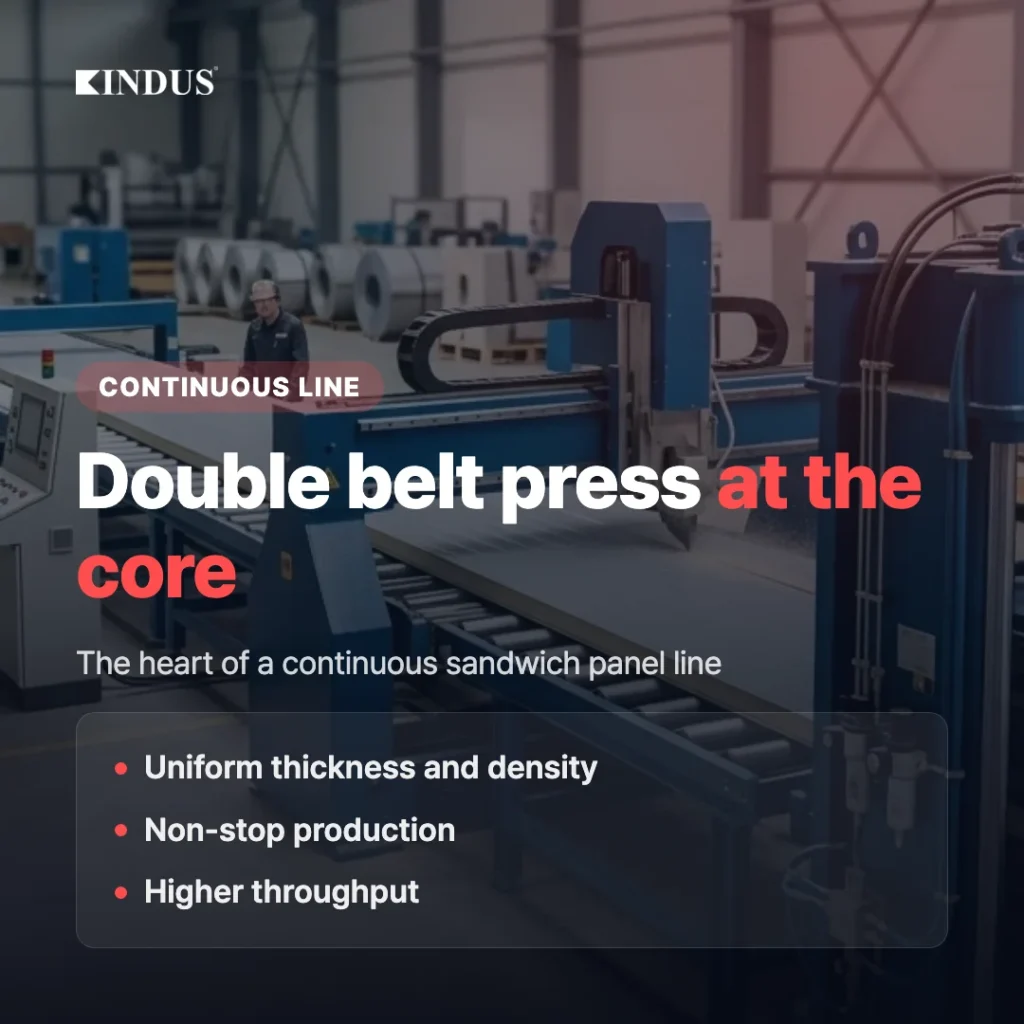
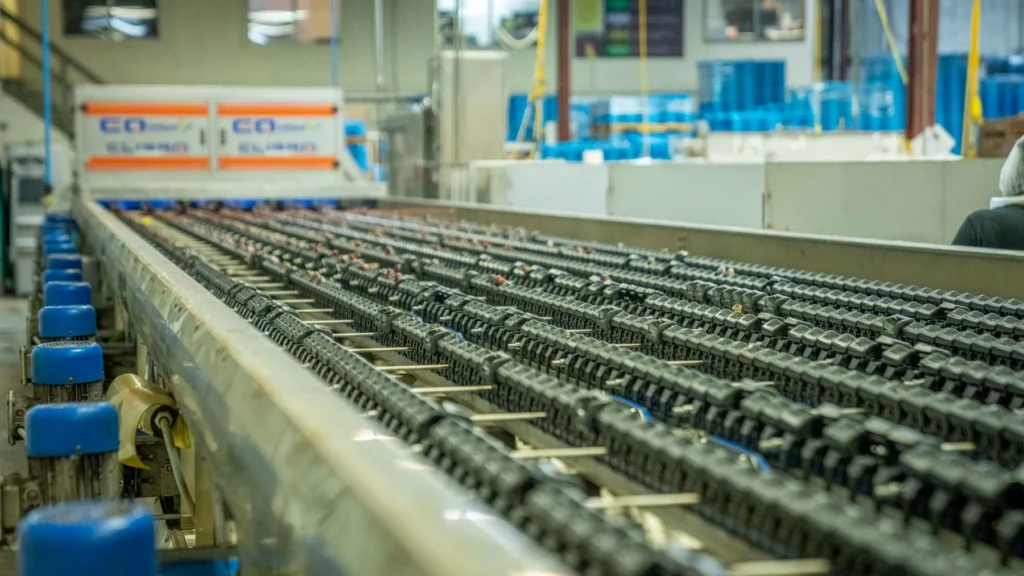
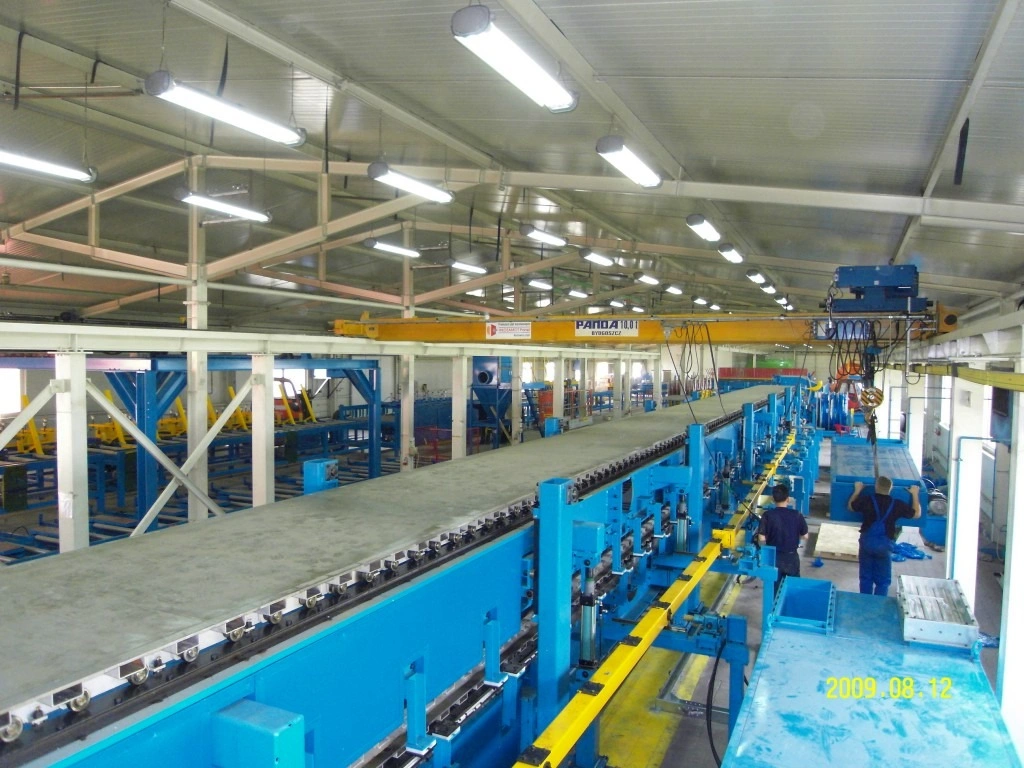
On continuous production lines, the pressing function is performed by a double belt press (also called a double belt conveyor or laminator). Two endless steel belts — one above and one below the panel — apply continuous uniform pressure across the full panel length as it travels through the heated zone. The upper belt can be height-adjusted to set the panel thickness. Internal heating platens maintain the belt surface at the temperatures required to accelerate adhesive cure or promote foam rise and crosslinking.
Pressure and temperature parameters vary by core type:
For PU/PIR panels, the press gap is set to the target panel thickness, and belt temperature is typically 40–60°C on the lower belt and 30–50°C on the upper belt. Higher temperatures accelerate the foaming reaction and improve skin formation on the foam surface, but excessively high temperatures can cause core delamination or face sheet paint damage. Line speed is adjusted in coordination with the chemical system’s reactivity (cream time, gel time, tack-free time).
For mineral wool panels, press temperature is lower (ambient to 40°C) since adhesive cure rather than chemical reaction is the objective. The press must apply sufficient pressure to ensure full contact between the wool slab and the adhesive-coated face sheets across the entire panel width. Pressure uniformity is particularly important for mineral wool because variations in wool density can create local voids.
For EPS panels, press parameters are similar to mineral wool: moderate pressure, near-ambient temperature, with dwell time determined by adhesive open time and cure speed.
How does line speed affect panel quality in the press section?
Line speed must be matched to the chemical or adhesive system’s reaction kinetics. If the line runs too fast, the PU foam may not have fully risen and gelled before the panel exits the press, leading to underfilled cores or delamination. If it runs too slow, over-compression of the foam can collapse the cell structure, reducing insulation performance. For mineral wool and EPS lines, line speed affects adhesive cure: insufficient dwell time results in low peel strength. Modern production lines use PLC-controlled variable speed drives and closed-loop temperature feedback to maintain optimal press parameters automatically.
On discontinuous (batch) production lines, the same principles apply, but pressing occurs in a fixed-position press rather than a moving belt system. Discontinuous lines are better suited to short production runs or thick panels above 200 mm where double belt presses become impractical.
Learn more about PU/PIR machine overview: PU/PIR Sandwich Panel Machine: Complete Technical Overview
Cutting, Cooling and Stacking
After pressing, the continuous panel strip — or individual panel blanks from a discontinuous line — must be cut to length, cooled, and stacked for storage or dispatch.
On continuous lines, cutting is performed by a flying saw system. A circular saw or cold-cut blade is mounted on a carriage that accelerates to match the line speed, makes the cut, and then returns to the starting position — all while the panel continues moving without stopping. Flying saw systems allow true continuous production with no interruption in panel flow. Cut length is programmed via the PLC and can be changed between cuts, enabling variable panel lengths in a single production run. Typical cut accuracy is ±2 mm over the panel length.
On discontinuous lines, a fixed panel saw performs the cut after each press cycle. This is simpler mechanically but limits throughput compared to a flying saw. For some applications — particularly thick mineral wool panels or custom profiles — discontinuous cutting is preferred because it allows more precise length control and easier handling of heavy panels.
After cutting, panels must be cooled before stacking and packaging. Hot panels — particularly PU/PIR panels immediately after foaming — continue to off-gas and carry residual heat that can cause deformation, surface waviness, or adhesive creep if stacked under load while still warm. Cooling tunnels use forced-air convection to reduce panel surface temperature to below 40°C (typically 35°C or lower for export packaging). Cooling tunnel length and airflow rate are sized to the line speed and panel thickness: thicker panels store more thermal energy and require longer cooling times.
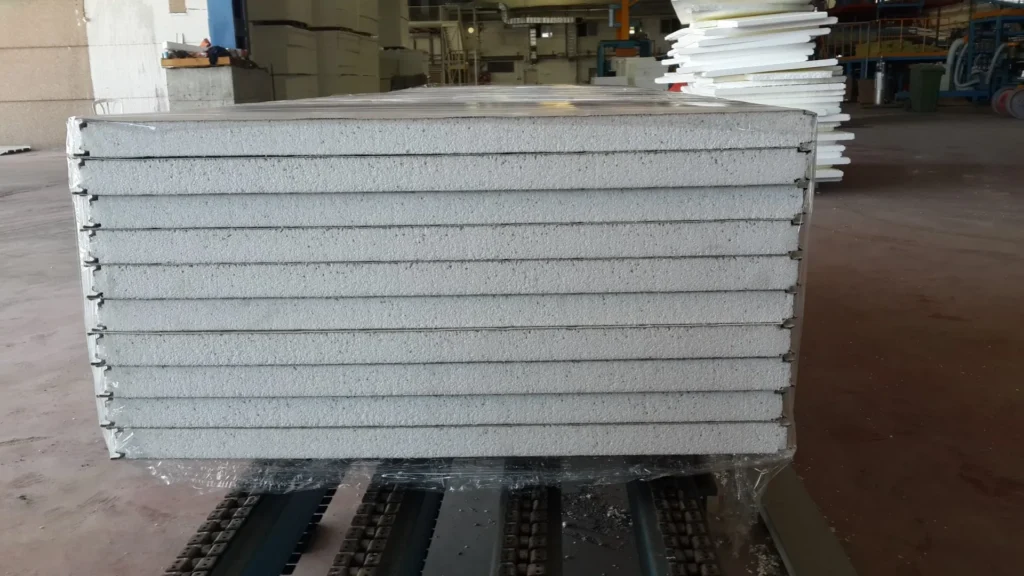
After cooling, panels are transferred to an automated stacking system. Stacking robots or gantry systems pick panels from the conveyor and build stacks of specified height. Interleaving layers of cardboard or foam separators between panels protect face sheet surfaces from scratching. Stack height is limited by the structural capacity of the bottom panel and the requirements of the transport vehicle — typically 1.8–2.5 m maximum stack height for road transport.
Quality Inspection and Packaging
The final stage of the production process encompasses inline quality inspection, end-of-line testing, and export packaging. This stage is increasingly automated on modern lines, with sensors and vision systems replacing manual measurement for many parameters.
Inline thickness measurement is performed using laser or ultrasonic sensors positioned after the press exit. Sensors measure panel thickness at multiple points across the width continuously during production. Any deviation from the target thickness beyond the tolerance band (typically ±0.5 mm for standard panels) triggers an alarm, and the affected panels are flagged for rejection or rework. Thickness data is logged against panel serial numbers for traceability.
Adhesion testing is performed on sample panels taken at defined intervals — typically one panel per production hour or per coil change. The standard test is the tensile adhesion (pull-off) test for PU panels, and the peel strength test for mineral wool and EPS panels. Minimum adhesion values are defined by product standards such as EN 14509 (for metal-faced insulated sandwich panels) and by customer specifications. Panels that fail adhesion testing trigger a production hold and root cause investigation.
Visual inspection covers face sheet surface quality (scratches, dents, paint defects), edge straightness, end squareness, and panel flatness. Automated vision systems can detect surface defects at line speeds up to 10 m/min with greater consistency than manual inspection.
The quality inspection checklist for sandwich panel production includes:
- Thickness measurement at ≥3 points across panel width — within ±0.5 mm tolerance
- Length measurement — within ±2 mm tolerance
- Squareness check — diagonal difference ≤3 mm per 1000 mm length
- Surface visual inspection — no scratches exceeding 0.2 mm depth, no dents, no paint holidays
- Adhesion / peel strength test (sampled) — meets EN 14509 or project specification minimum
- Core density check (sampled, PU/PIR) — within ±2 kg/m³ of target
- Thermal conductivity verification (batch sampling, laboratory) — meets declared λ-value
- Edge profile check — labyrinth or tongue-and-groove joint dimensions within tolerance
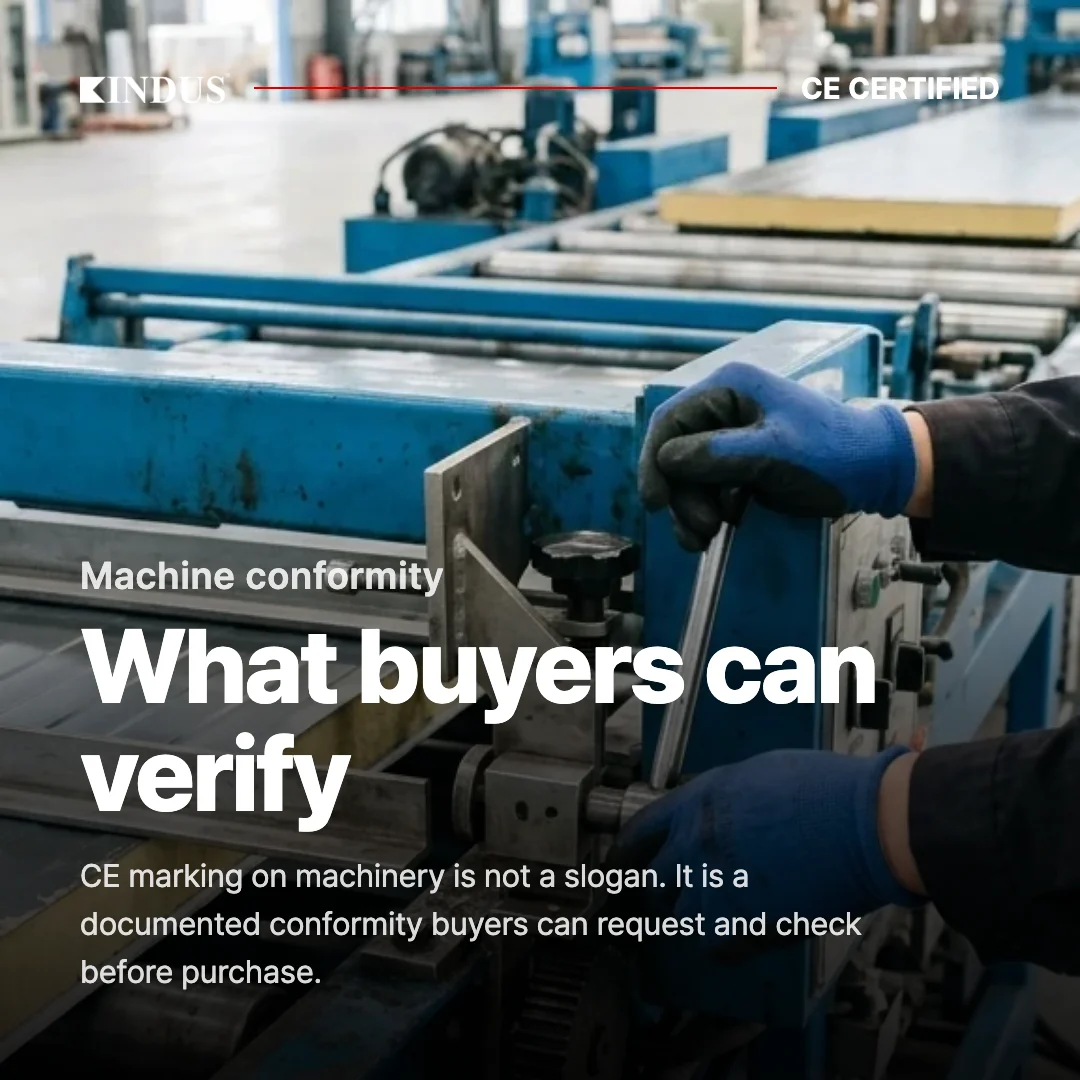
KINDUS integrates CE-marked production line equipment with documentation packages that support EN 14509 factory production control (FPC) requirements, enabling panel manufacturers to maintain consistent quality records required for third-party certification.
Export packaging is the final step before dispatch. Panels are wrapped with stretch film, corner protection is applied, and panels are banded onto timber export pallets or steel frames. For sea freight, additional moisture barrier wrapping and silica gel desiccant packs are used inside the pallet wrap to protect face sheet surfaces from condensation during ocean transit. Pallet dimensions, weight limits, and marking requirements are coordinated with the shipping and customs documentation.
Learn more about sandwich panel production line types Sandwich Panel Production Line: Types, Technology & How to Choose
Frequently Asked Questions
What are the main steps in sandwich panel manufacturing?
The main steps are: (1) raw material preparation — steel coil decoiling, surface cleaning, and roll forming of face sheet profiles, plus core material staging; (2) core material application — liquid chemical pour for PU/PIR, adhesive-bonded slab placement for mineral wool, or adhesive-bonded block feeding for EPS; (3) panel forming and pressing in a double belt press or fixed press; (4) cutting to length using a flying saw (continuous lines) or fixed saw (discontinuous lines); (5) cooling in a cooling tunnel; (6) automated stacking; and (7) quality inspection and export packaging. Each step has material-specific parameters that must be controlled to achieve consistent panel quality.
How does the core material application differ between PU and mineral wool?
PU core is applied as a reactive liquid mixture — polyol and isocyanate are combined in a high-pressure mixing head and poured onto the moving lower face sheet, where the mixture expands and foams to fill the space between the face sheets, bonding chemically as it cures. No external adhesive is required because the foam adheres to the metal faces during the reaction. Mineral wool core, by contrast, is a pre-formed inert solid material. Rock wool slabs are cut to size, oriented in lamellar configuration (fibers perpendicular to the panel face), and bonded to the face sheets using a two-component adhesive applied before pressing. The fundamental difference is reactive chemical bonding (PU) versus mechanical adhesive bonding (mineral wool), which drives the differences in press temperature, line speed, and process control requirements.
What quality checks are performed during production?
Standard inline quality checks include continuous thickness measurement by laser or ultrasonic sensors, visual surface inspection (automated or manual), length and squareness measurement after cutting, and edge profile verification. Sampled off-line checks include adhesion/peel strength testing, core density measurement (for PU/PIR), and thermal conductivity verification. Panels must meet dimensional tolerances and mechanical performance requirements defined by EN 14509 or equivalent project standards. A factory production control (FPC) system is required for CE marking, which means that all inspection results must be recorded and retained for traceability.
Whether you are evaluating a greenfield panel factory investment, upgrading an existing production line, or optimizing your current process for a new core material, selecting a line supplier with deep application knowledge across all three core types is critical to achieving consistent output quality and reliable uptime.